Template · 25-page PDF · Premium
Exam Preparation Planner: Daily Schedule + Weak-Topic Tracker
Build a realistic exam preparation planner in 15 minutes: day-by-day grid, weak-topic tracker and exam-eve checklist. Start your plan today.

The full workbook, ready to print
- ✓Printable day-by-day study grid with a filled-in worked example
- ✓Weak-topic tracker with confidence scoring and a day 1/3/7/14 spaced review ladder
- ✓Adaptation sheets for ADHD, anxiety, shift work, parenting and noisy homes
- ✓Target-score worksheet for IELTS-style exams, from diagnostic to band gap
- ✓The last-72-hours triage plan and exam-eve checklist
- ✓Full print pack of every template, reusable for next session
Hosted on FileJoker. Premium members download instantly; free download has a wait.
In a hurry? Free one-page checklist24 items to tick off · print-ready PDF, no sign-upDownload freeA look inside the PDF
10 sections · 25 pages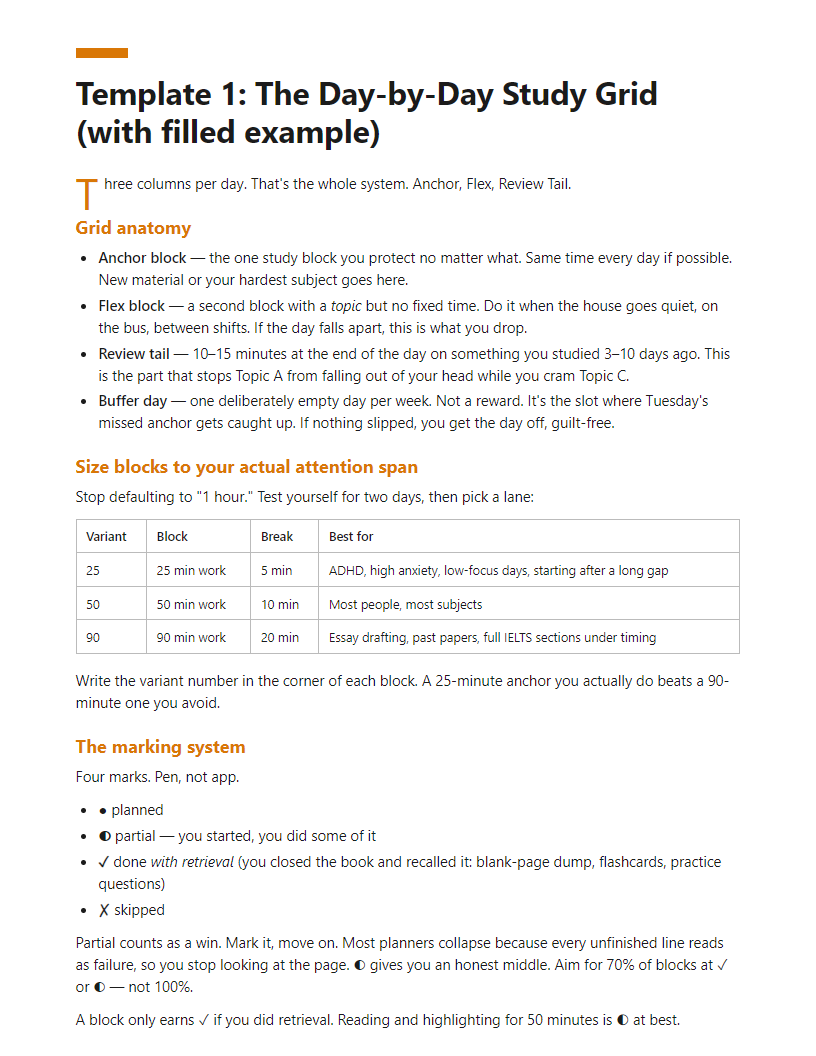
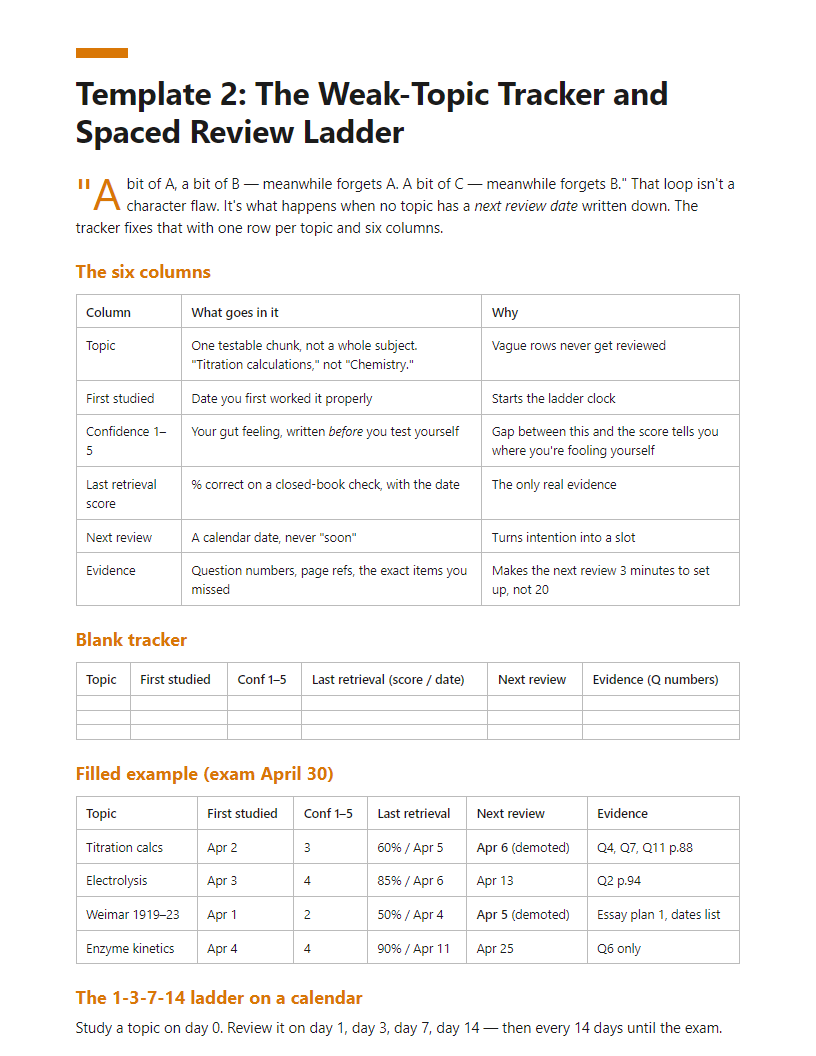
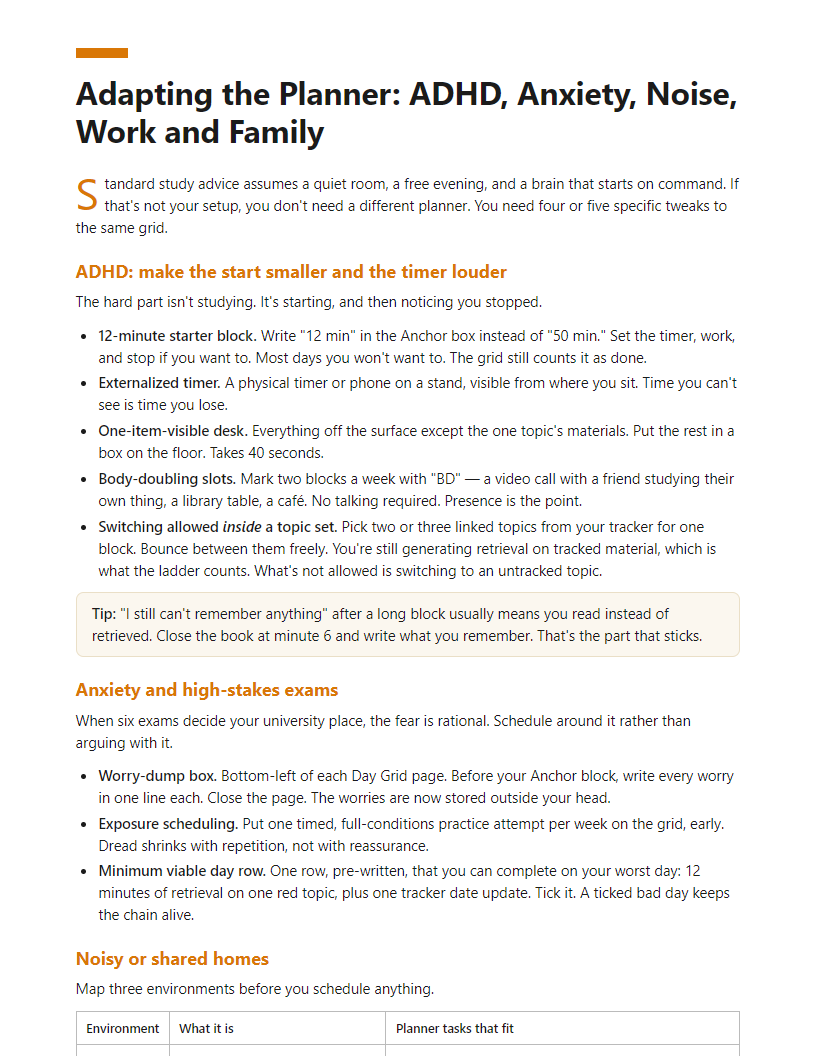
Full table of contents
- Why Most Study Planners Collapse in Week Two
- The 15-Minute Answer: How to Build an Exam Plan Right Now
- Choosing Your Countdown: 90 Days, 4 Weeks, or 72 Hours
- Template 1: The Day-by-Day Study Grid (with filled example)
- Template 2: The Weak-Topic Tracker and Spaced Review Ladder
- Adapting the Planner: ADHD, Anxiety, Noise, Work and Family
- Target-Score Prep: Using the Planner for IELTS and Similar Exams
- The Last 72 Hours: Triage Plan and Exam-Eve Checklist
- Eight Planning Mistakes That Waste Revision Weeks
- Print Pack: All Templates and How to Reuse Them Next Session
In this article
You open the textbook three days before the exam, panic, and search for study tips you should have found six weeks ago. Or you revise Topic C and quietly forget Topic A. Or you sit for four hours, highlight everything, and retain almost nothing — then feel guilty about the to-do list you never finished.
This page gives you a working exam preparation planner you can build in about fifteen minutes: how to pick your countdown (90 days, 4 weeks or 72 hours), how to schedule interlinked topics, and the eight planning mistakes that quietly waste whole revision weeks. The premium PDF adds the printable grids themselves — a filled day-by-day study grid, a weak-topic tracker with a spaced review ladder, and an exam-eve triage checklist.
The short answer
To build an exam preparation planner that survives past week two:
- Count backwards from the exam date and pick your window: 90 days, 4 weeks or 72 hours.
- List every topic, then mark each one strong, shaky or unknown.
- Block fixed time around work, classes and sleep — plan only the hours you actually have.
- Schedule new topics in the morning slot, reviews in the evening slot, so older material keeps resurfacing.
- Add a spaced review ladder: revisit each weak topic at day 1, 3, 7 and 14.
- Reserve the final 72 hours for past papers, triage and an exam-eve checklist — not new material.
Why Most Study Planners Collapse in Week Two
You made a timetable. Sunday night, color-coded, every hour blocked. By Wednesday of week two it’s wallpaper. Here’s why that happens, in four patterns. Find yours.
1. The over-scheduled timetable. You planned 6 hours a day on top of classes, work, or a commute. You missed one block, then two, and the whole grid lost credibility. A plan you can’t hit twice in a row stops being a plan.
2. Topic-switching amnesia. You study Topic A in week one, Topic B in week two, and by the time you reach Topic C, Topic A is gone. “I’m in my 6th semester and I don’t recall what I learned.” Nothing in a standard timetable forces you back to old material.
3. The guilt spiral. Unfinished to-do items roll over. The list grows. Opening the planner now feels bad, so you don’t open it. Procrastination here isn’t laziness — it’s avoidance of a document that only ever reports failure.
4. Hours logged, nothing retained. You sat for four hours, highlighted, re-read, felt productive, and can’t answer a single exam question on it. Time in the chair was never the metric.
Why pretty timetables fail
They schedule time, not retrieval. A box labeled “Biology 4–6pm” doesn’t say what you’ll do or how you’ll know it worked. Fix that and most of the other problems shrink.
The system, in one page
- The Day Grid — what you touch each day, in blocks you’ll actually complete.
- The Weak-Topic Tracker — a list of your shaky topics with review dates that force old material back in front of you.
- The Exam-Eve Checklist — the 24-hour script so the night before isn’t improvised panic.
Pick your lane now
| You are | Go to |
|---|---|
| 90 days out | Section 3, then the 90-day overview grid in Template 1 |
| 4 weeks out | Section 3, then the 4-week grid in Template 1 — start at Day 10 |
| 72 hours out | Skip to Section 8 |
What you need: a printer, a pen, and 25 minutes. No apps, no sign-up, no subscription.
The 15-Minute Answer: How to Build an Exam Plan Right Now
Grab a sheet of paper and a timer. Fifteen minutes from now you’ll have a draft plan. It won’t be perfect. It will be usable — even if your exam is in three days.
Step 1: Count your real hours (4 minutes)
Draw three columns: Days left, Hours on paper, Hours I’ll actually get.
Count the days until your exam. For each day, write the hours that look free. Then subtract: commute, meals, work shifts, childcare, the class you have to attend, and one hour of slack for life going wrong. What’s left is your real number.
As a rule of thumb, expect to cross out roughly half of what looked free. That’s normal. A plan built on 18 real hours beats a plan built on 40 imaginary ones.
Warning: If your real number is under 10 hours, skip to the 72-hour triage plan in section 8. Don’t try to cover everything.
Step 2: Dump and rate every topic (4 minutes)
List every topic on the syllabus. Not chapters — topics, the way the exam asks about them. One line each.
Rate each one 1–5 for confidence, fast, gut answer only. 5 means you could teach it. 1 means you’d leave the question blank.
Anything rated 3 or below goes on your weak-topic tracker. That list is now the spine of your plan.
Step 3: Split your hours 60/25/15 (2 minutes)
Take your real hours number and divide it:
| Share | Goes to | 20 real hours = |
|---|---|---|
| 60% | Weak topics (rated 1–3) | 12 hours |
| 25% | Review of “finished” topics (4–5) | 5 hours |
| 15% | Timed practice questions | 3 hours |
That 25% is the part everyone cuts. It’s the reason you learn topic A, move to B, and find A has evaporated by the time you reach C.
Step 4: Lock one anchor slot (3 minutes)
Don’t build an hour-by-hour timetable. Pick one time slot you can hit every single day — 7:00–8:30 a.m., or 9:00–10:00 p.m. after the kids are down. Write it down. That’s your anchor.
Everything else is a bonus. Missing a bonus session isn’t failure. Missing your anchor two days running is the signal to shrink the slot, not quit.
Step 5: The 10-minute rule (2 minutes)
End every study day with 10 minutes on a topic you last touched three or more days ago. No notes open first — recall it, then check.
Write the rule at the top of your plan. It’s the single line that stops the A-B-C forgetting loop.
Choosing Your Countdown: 90 Days, 4 Weeks, or 72 Hours
Three horizons, three different jobs. Pick by the calendar, not by how prepared you wish you were.
Which template to print
| Days until exam | Subjects/papers | Your confidence now | Print this |
|---|---|---|---|
| 60+ | Any number | Any | 90-day grid |
| 22–59 | 1–3 | Shaky on most topics | 90-day grid, compressed |
| 22–59 | 4+ | Mixed | 4-week grid |
| 8–21 | Any number | Any | 4-week grid, start at day 10 |
| 0–3 | Any number | Any | 72-hour triage sheet |
If you’re between two rows, choose the shorter horizon. Short plans survive contact with real life.
90 days: coverage first
Weeks 1–2 are for mapping and covering content. From week 3 on, every study block ends with 10 minutes of closed-book retrieval on something you studied earlier. The sacrifice: you give up the comfort of “finishing” a subject before moving on. You’ll revisit topic A while topic C is still new.
4 weeks: coverage and review in parallel
No pure-coverage phase. Each day gets one new topic and one old topic. Full practice papers start on day 10, under timed conditions, even if you feel unready. The sacrifice: depth. You cover the syllabus at a reading-and-testing level, not a mastery level.
72 hours: triage on purpose
If you found this guide two days before your exam, you are not out of options — you just have to choose losses deliberately. Rank topics by marks per hour: likely marks on the paper ÷ hours needed to get them.
| Topic | Likely marks | Hours to competence | Marks/hour | Verdict |
|---|---|---|---|---|
| Definitions, formulas | 20 | 2 | 10.0 | Do first |
| Graph interpretation | 15 | 3 | 5.0 | Do second |
| Essay-length case study | 25 | 8 | 3.1 | Skim only |
| Rare proof topic | 6 | 6 | 1.0 | Abandon |
Write “abandoned” next to the loser. Naming it stops the guilt loop that eats your remaining hours.
Switching horizons mid-prep
Allowed, and common. If life eats three weeks, don’t rebuild from scratch — copy your weak-topic tracker rows onto the shorter template, keep the review dates, and re-rank by marks per hour. The tracker carries over; only the grid changes.
Eight Planning Mistakes That Waste Revision Weeks
1. Color-coding before test-driving
Pretty timetables feel like progress. They aren’t. Run one ordinary day on the plan first — a Tuesday, not a fantasy Sunday. If you finished the blocks, keep the layout. If you didn’t, cut 25% and try again.
The test-drive also tells you your real block size. Most people discover they planned 50-minute blocks and ran out of attention at 30. Fix the number before you commit four weeks to it. Markers come last, if at all.
2. Scheduling by subject, not by topic
“Do Chemistry, 2 hours” lets you spend both hours on the part you already like. Weak sub-topics hide inside subject labels, and two hours of comfortable chemistry still reads as two hours done.
Write the topic and the task, with a finish line attached: Chemistry — electrolysis, 12 past-paper marks, closed book. A finish line you can check off in 40 minutes also kills the “I’ll start after dinner” delay, because the job is now small and obvious. If a line on your grid can’t be marked done or not-done, it’s a subject label, not a task.
3. Finishing Topic A “completely” before touching B
The symptom: you bounce between topics out of boredom, then force yourself back to A because leaving it unfinished feels wrong. Give every topic a next-review date in the tracker (section 5) and the bouncing stops being a problem — and where A, B and C build on each other, interleave them on purpose.
4. Counting re-reading and highlighting as study time
This is the main cause of “I studied for hours and remember nothing.” The grid’s ✓ mark (section 4) only applies if you produced something — answers, a blank-page recall, a worked problem; everything else is ◐.
5. Planning a 9-hour Saturday you’ve never completed
If your plan depends on a day you have never actually finished, it fails in week two. Plan 80% of your real best day and keep the weekly buffer day from section 4 for the blocks that slip.
6. Dropping the tracker in the final week
Week one of the countdown, people review faithfully. Final week, panic takes over and everything becomes new cramming. That’s backwards — the last seven days is when old topics decay fastest, and decay in a topic you already learned costs you more marks than a topic you never started.
Keep the review ladder running even if each review is only 10 minutes. Three red topics at 3 minutes each still beats one hour on brand-new material you’ll half-remember. Protect the Review Tail before you protect anything else.
7. Treating a missed day as plan failure
One missed day ends more plans than anything else — not the lost hours, the guilt. Use the two-item carry-forward rule from section 4: move the two most important items to the buffer, delete the rest, and keep going.
8. Allocating hours to material that isn’t on the exam
Before you build the schedule, get the actual syllabus or exam specification and the list of topics your teacher covered. Mark anything on the spec your class skipped. Email the teacher or check the course page to confirm whether it’s examinable.
Do the same check on your materials. Past papers from an older spec, a secondhand textbook, a friend’s notes from a different module — all of them can send you studying content that can’t be tested. Thirty minutes of checking saves days.
Tip: Do the syllabus check in week one. Finding an uncovered topic 72 hours out is a crisis; finding it on day 85 is a Tuesday.
Paid Planner vs Free Tools: An Honest ROI Comparison
You don’t need to buy anything to use this system. But you do need to pick a format and stop switching. Here’s the honest comparison.
The price question, answered first
Paid printable planner packs generally sit in the $5–$20 range (check current pricing before you buy). Treat that as a swap: money for setup time. At $10, you break even if the pack saves you roughly 40 minutes of building and formatting — less than half of one spreadsheet session. If you’d happily spend two hours making your own grid and enjoy it, the free route wins. If you’ve already “started a tracker” twice and abandoned both, $10 buys you the version that’s finished.
What free AI schedulers do well
Ask a chatbot to split 14 topics across 26 days and it will do the arithmetic instantly. It’s good at calendar math, at spreading subjects evenly, and at spitting out a tidy list. Paste the result into a calendar app and you get reminders for free.
Where it fails: it doesn’t know which topics you keep forgetting. It can’t schedule a next review date that moves based on how a recall test went. And it has no exam-eve protocol — no triage, no bag check, no stop time.
Spreadsheet DIY
A spreadsheet tracker is genuinely good, and if “someone just opening Excel and showing you” is what clicks for you, build it. Budget 1–2 hours for the first version, plus tinkering time you’ll pretend is studying. A printed grid takes 90 seconds to fill in on a bus.
The notification problem
A phone planner lives inside the machine that interrupts you. Opening the app to check your block puts you one swipe from the thing you’re avoiding. Paper can’t notify you about anything.
| Paid printed pack | Free printable (this guide) | Free AI generator | Spreadsheet DIY | |
|---|---|---|---|---|
| Cost | $5–$20 + paper | Paper only | $0 | $0 |
| Setup time | 5–15 min | 15–30 min | 2 min | 1–2 hrs |
| Retrieval / spaced review support | Built in | Built in | None | Only if you build it |
| Distraction risk | Very low | Very low | High | Medium |
| Works in exam-style conditions | Yes | Yes | No | No |
When paper wins outright
- Exam eve, when opening your phone invites panic-scrolling and group chats.
- Noisy or shared spaces where you can’t rely on a screen staying open.
- ADHD externalizing — the plan sits visible on the desk instead of in a closed app you forget exists.
- Timed practice, where you’re training for a paper-and-pen room.
The hybrid that actually holds
Paper tracker for topics and review dates. Phone for one job only: a timer. Calendar for fixed appointments — mock tests, the exam itself. Nothing else gets notification rights.
Exam Planner FAQ
How many hours a day should I actually study? Is 8 hours realistic?
For most people, no — not for weeks on end. Four to five focused hours is a strong day. Six is a lot. If you’re also working or in class, two to three real hours is a win.
Count focused hours, not hours at the desk. Eight hours of scrolling with a textbook open is zero.
I have 2 days left. Is a planner still worth making?
Yes, and it takes 10 minutes. With 48 hours, the planner’s job changes: it stops you from spending all of Saturday on the first chapter.
Write the list of topics. Mark the high-mark ones you half-know. Those get your time. The topics you’ve never opened get a 20-minute skim and nothing more. See the last-72-hours triage plan.
Should I finish one topic or switch between topics?
Switch — but switch between study sessions, not every 10 minutes. One topic per block, two or three topics per day, is the sweet spot for recall.
The common objection is fair: if Topic B builds on Topic A, you can’t jump around. True. Learn in order, review out of order. First pass follows the syllabus; every review session after that mixes topics so your brain has to pick the right method, not just repeat the last one.
Tip: If topics A, B and C are interrelated, that’s an advantage. Make your review question “how does A connect to C?” You’ll cover both.
How do I plan when I don’t know what’s on the exam?
Work from evidence, not guesswork. Past papers, the official syllabus or spec, the question types your teacher repeats, and anything they said twice in class. Those four sources cover most of it.
Teachers do sometimes test material you haven’t covered. You can’t plan that away. What you can do is build 15 minutes of “unknown topic” skimming into your last week so nothing is completely foreign.
How do I fit revision around a job, kids, or a noisy house?
Shrink the block, don’t cancel the day. A protected 25 minutes beats a planned 3-hour session that never happens.
Find your quiet window and defend it — early morning before the house wakes, a lunch break, 30 minutes after bedtime. If days are loud and nights are the only quiet time, plan for it openly instead of fighting it: set a fixed end time so late study doesn’t eat your sleep.
I fell three days behind. Restart or carry forward?
Neither. Don’t restart, and don’t carry three days of debt. Cross off the missed days and start again from today’s date.
Missed sessions aren’t a backlog, they’re information: your plan asked for more than your life allows. Cut one block per day and keep going.
Does spaced repetition work for essay subjects?
Yes, but review differently. For facts you recall the answer. For essays you recall the structure — the thesis, three arguments, two pieces of evidence each. Write that skeleton from memory in five minutes, then check it. Same ladder, same review dates.
- ✓Printable day-by-day study grid with a filled-in worked example
- ✓Weak-topic tracker with confidence scoring and a day 1/3/7/14 spaced review ladder
- ✓Adaptation sheets for ADHD, anxiety, shift work, parenting and noisy homes
- ✓Target-score worksheet for IELTS-style exams, from diagnostic to band gap
- ✓The last-72-hours triage plan and exam-eve checklist
- ✓Full print pack of every template, reusable for next session
Frequently asked questions
How far ahead should I start planning for an exam?
Eight to twelve weeks is ideal for a major exam, four weeks is workable, and 72 hours is damage control. The window matters less than the structure: with 90 days you can run full spaced review cycles; with 4 weeks you cut content to high-yield topics; with 3 days you triage, drilling only what is both heavily weighted and still shaky.
How do I stop forgetting earlier topics while learning new ones?
Use a spaced review ladder instead of linear coverage. Every topic you finish gets scheduled again at day 1, day 3, day 7 and day 14 — short 10–15 minute retrieval sessions, no re-reading. Track each topic on a weak-topic sheet with a confidence score so you can see which ones are genuinely decaying and which are stable.
What should a 3-day cramming plan look like?
Day 1: list every exam topic, score your confidence, and cut anything low-weight or unknowable in time. Day 2: active recall only on high-weight shaky topics — past questions, blank-page recalls, worked examples. Day 3: one timed practice paper in the morning, light review of error notes, then stop by evening and run the exam-eve checklist. No new material after day 2.
How do I plan revision with ADHD, anxiety or a noisy home?
Shorten the unit of work: 20–25 minute blocks with a written "next action" so restarting costs nothing. Plan by task completed, not hours sat. Build in two deliberate empty slots per week so one bad day doesn't collapse the schedule, and pair noisy hours with low-focus work like flashcards or past-paper marking.
Is a paid exam planner worth it versus free apps and spreadsheets?
A paid planner is worth it if your problem is structure, not motivation — it removes the hours spent designing grids and deciding what to revise when. Free apps work well for reminders but rarely handle topic interference or spaced review. If you abandon digital tools within a week, a printable format you physically tick is usually the better bet.
How do I plan for a target score on IELTS or a similar test?
Work backwards from the band or score you need. Take one diagnostic test, convert each section into a gap figure, then allocate planner time proportionally to the largest gaps — not evenly. Schedule one timed full section per week, plus daily micro-drills on the specific sub-skill holding you back, and re-test every two to three weeks.
We collected 110 real questions and comments about "exam preparation planner" (91 from YouTube comments, 19 from search suggestions), grouped them into 12 recurring problems, and built this guide to resolve the 7 that block people most. The top-ranking pages were reviewed for gaps; 7 of those gaps became dedicated sections.
Edited by Alex Horn · Last updated November 14, 2026 · How we make our guides
