Checklist · 17-page PDF · Free
Grocery Shopping List for a New Apartment (With Real Costs)
Grocery shopping list for a new apartment: what to buy first, real monthly costs for one, and a free printable checklist in economy, standard and extended. Get it free.
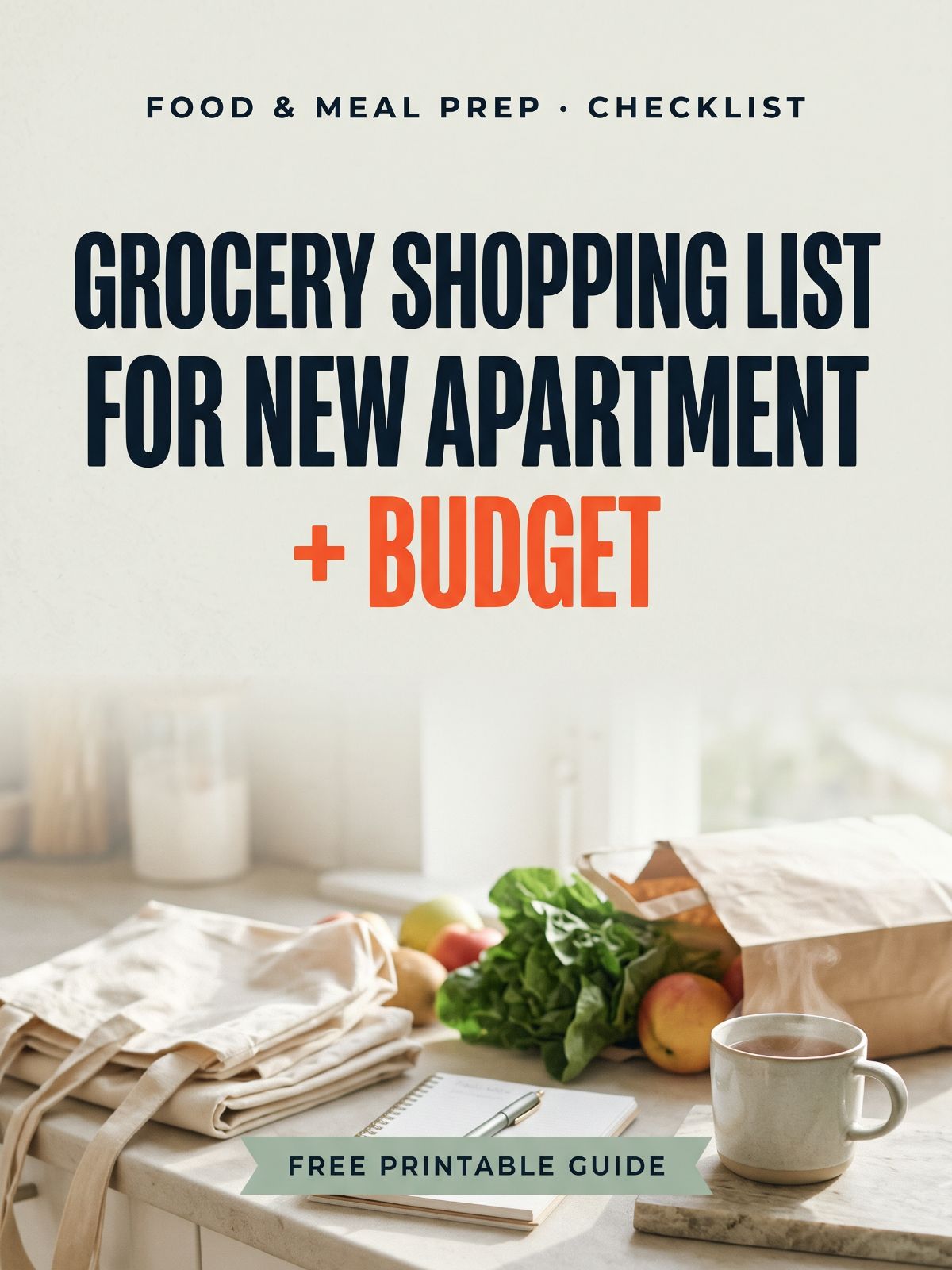
The full guide as a PDF
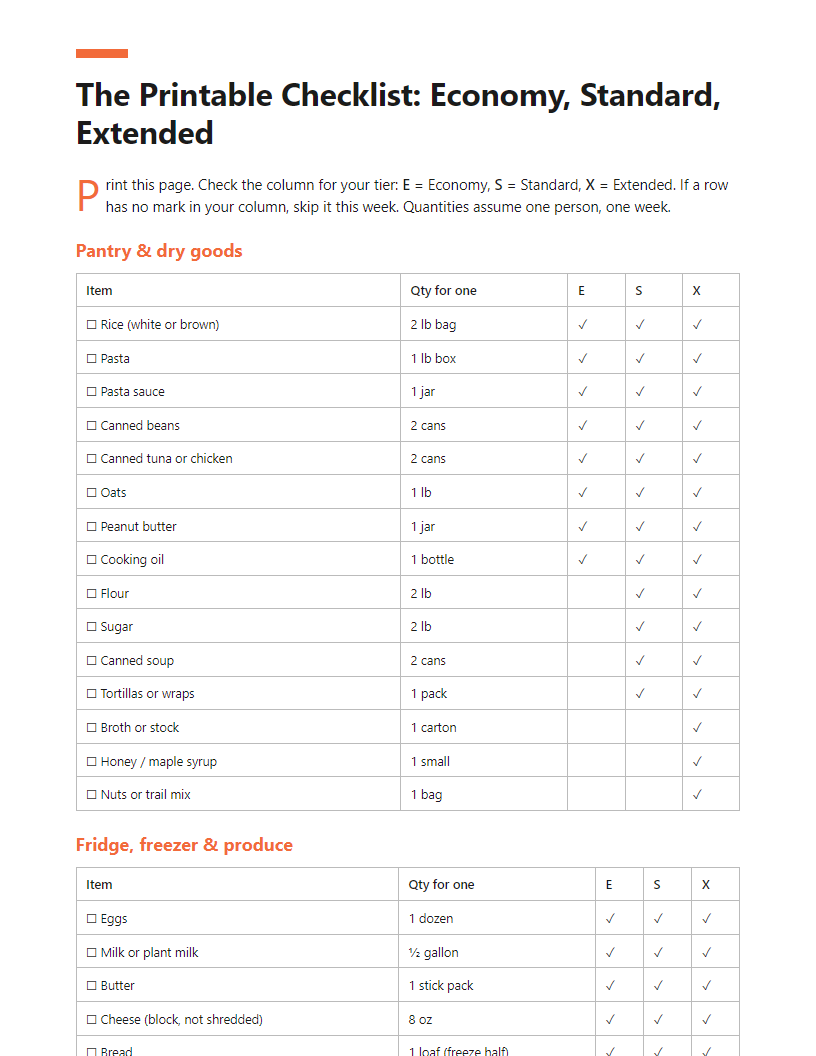
- ✓Printable checklist in three columns: economy, standard and extended basket
- ✓Six-step first-shop plan, from pantry audit to checkout order
- ✓Combined grocery + kitchen tools list (can opener, thermometer, containers) in one page
- ✓Buying-for-one portioning table: what to freeze, what to buy in twos
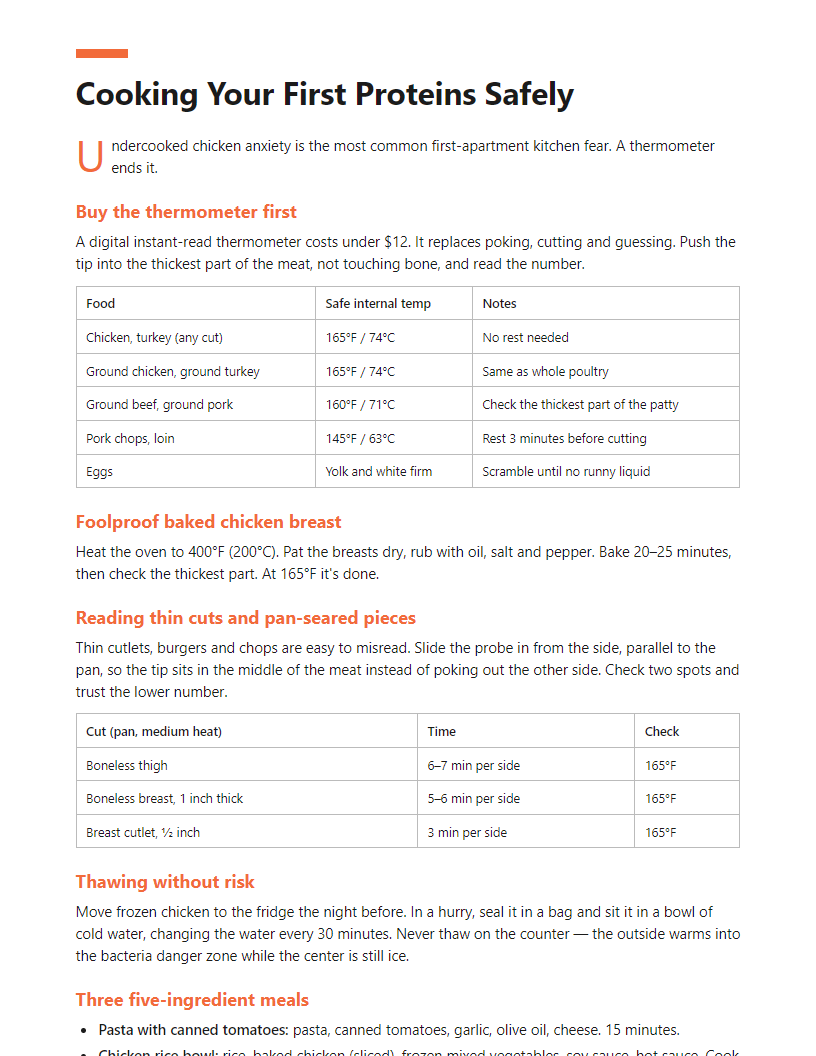
- ✓Safe internal temperature card for chicken, beef, pork, fish and eggs
- ✓Seven-day starter meal rotation built from nine 3-3-3 ingredients
- ✓Fridge, freezer and pantry storage chart with realistic shelf-life days
Hosted on FileJoker. Free download, no sign-up.
A look inside the PDF
8 sections · 17 pages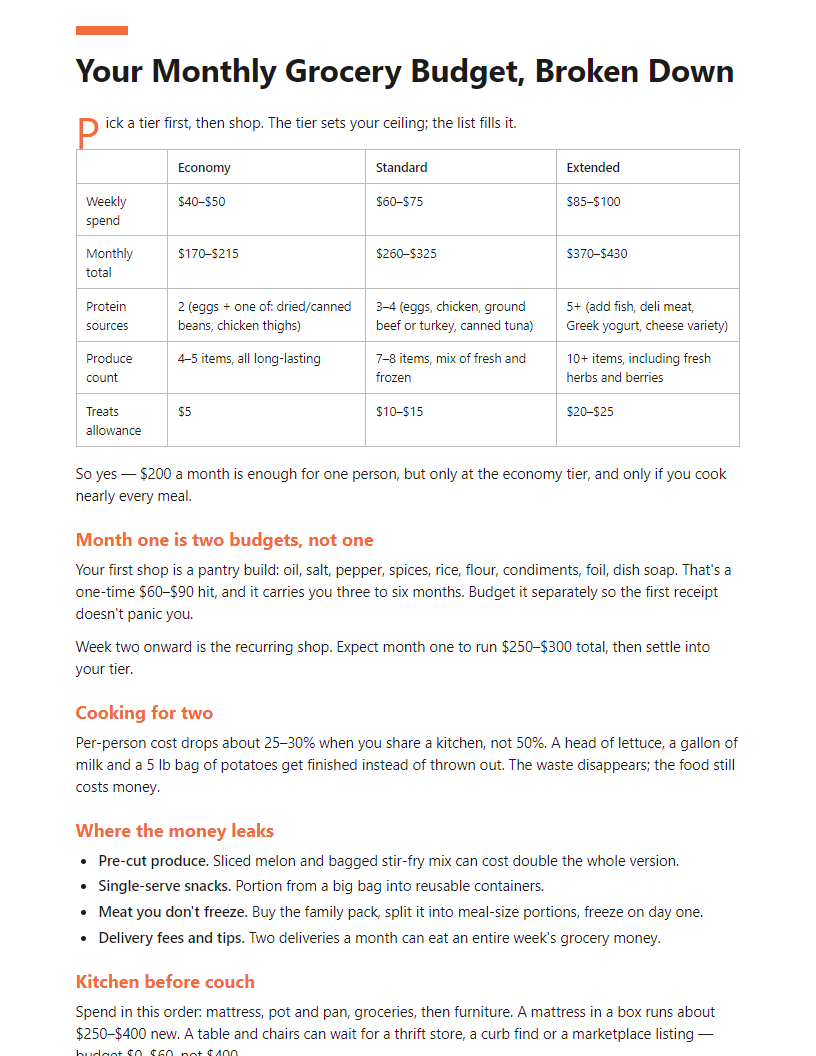
Full table of contents
- Your Monthly Grocery Budget, Broken Down
- The 5-4-3-2-1 and 3-3-3 Rules, Explained Plainly
- How to Do Your First Shop: Six Steps
- The Printable Checklist: Economy, Standard, Extended
- Buying for One Without Throwing Food Away
- Cooking Your First Proteins Safely
- Where to Shop: Store Comparison and Store Brands
- Eight Mistakes First-Time Shoppers Make
In this article
- The short answer
- Why Your First Grocery Run Goes Wrong
- The Short Answer: What to Buy and What It Costs
- Your Monthly Grocery Budget, Broken Down
- The 5-4-3-2-1 and 3-3-3 Rules, Explained Plainly
- Where to Shop: Store Comparison and Store Brands
- Eight Mistakes First-Time Shoppers Make
- Frequently Asked Questions
You have keys, an empty fridge and no idea where to start. “What do I actually need?” and “how much should this cost a month?” are the two questions nobody answers properly — so you end up with three sauces, no can opener, and a bag of spinach that turns to slime by Thursday.
This page gives you a grocery shopping list for a new apartment that merges food with the kitchen basics people forget, plus a realistic monthly budget for one person and a couple, the 5-4-3-2-1 and 3-3-3 rules explained simply, and a store-by-store price comparison.
The free PDF adds the printable checklist in three budget tiers, a six-step first-shop plan, buying-for-one portioning, and safe cooking temperatures for your first proteins.
The short answer
Build your first apartment grocery list in this order:
- Kitchen basics — can opener, knife, cutting board, pan, storage containers, trash bags, foil.
- Pantry staples — rice, pasta, oats, canned beans, tinned tomatoes, oil, salt, pepper, 4–5 spices.
- Proteins — eggs, chicken, mince or tofu; freeze what you won’t eat in 3 days.
- Produce — hardy first: onions, carrots, potatoes, apples; one bag of greens only.
- Dairy and freezer — milk, cheese, butter, frozen veg.
- Snacks and drinks last, with whatever budget remains.
Budget roughly $250–$350 a month for one person.
Why Your First Grocery Run Goes Wrong
You can spend $400 and still open the cabinet to find nothing you can make a meal out of. That’s the normal first-apartment experience, and it comes down to three predictable mistakes.
The two-cart problem. Food and kitchen tools get bought on separate trips, usually from separate stores. So you come home with pasta sauce and no can opener, chicken thighs and no spices, a full trash bag and no trash can. One list that mixes tools into the food categories fixes this. You buy the can opener in the same trip as the canned beans.
Shopping for four when you cook for one. Family-size habits are hard to drop. You buy the big spinach, the five-pound bag of apples, the gallon of milk. By day five, half of it goes in the trash. Cooking for one person means smaller units, more frozen, and planning repeats instead of variety.
Furniture debt eating the pantry. A mattress is one thing worth spending on — you sleep on it a third of your life. But if furniture, deposits, and a bed frame hit the same month as your first grocery run, groceries lose. Set the food number first, then furnish around it.
How to use this guide: read the budget numbers in the next two sections, pick your tier, print the matching checklist, and do one shop. Not three.
The Short Answer: What to Buy and What It Costs
The 20-item week-one list. These cover breakfast, lunch, dinner and snacks without leftovers rotting.
| Where | Items |
|---|---|
| Pantry (8) | Rice, pasta, pasta sauce, canned beans, canned tuna, oats, peanut butter, cooking oil |
| Fridge (6) | Eggs, milk, butter, shredded cheese, yogurt, bread or tortillas |
| Freezer (3) | 3 lb bag frozen chicken, frozen mixed vegetables, ground beef |
| Produce (3) | Onions, potatoes, bananas or apples |
Add a starter spice set on the same trip: salt, black pepper, garlic powder, onion powder. Four jars turn plain chicken into a meal.
What it costs per month (one person). Three tiers run through this whole guide — Economy, Standard and Extended.
| Tier | Monthly | What it looks like |
|---|---|---|
| Economy | $170–$215 | Store brands, nearly all meals cooked at home |
| Standard | $260–$325 | Some name brands, more fresh produce and meat |
| Extended | $370–$430 | Little price-checking, some prepared foods |
These are typical self-reported ranges, not official figures. For a government benchmark, check the current USDA Food Plans for your age and sex. Section 3 breaks each tier down by weekly spend, protein count and produce count, so pick your tier there before you shop.
Your first shop costs more than every shop after it. You’re buying oil, spices, condiments, flour, sugar and a full pantry in one hit. Budget $120–$180 as a one-time stock-up, separate from your weekly spend. After that, a solo week runs $40–$100 depending on your tier.
Is $200 a month enough for one person? Yes — under two conditions. First, you cook almost every meal at home; two takeout orders a week eats a quarter of that budget. Second, you buy store brands and shop a discount grocer. Break either condition and $200 won’t hold.
Five tools to buy before any food:
- Can opener (the single most forgotten item)
- Chef’s knife, 8-inch
- Cutting board
- 10-inch nonstick skillet
- Medium pot with a lid
Also grab a trash can and trash bags the same day. You’ll generate garbage before you cook anything.
Your Monthly Grocery Budget, Broken Down
Pick a tier first, then shop. The tier sets your ceiling; the list fills it.
| Economy | Standard | Extended | |
|---|---|---|---|
| Weekly spend | $40–$50 | $60–$75 | $85–$100 |
| Monthly total | $170–$215 | $260–$325 | $370–$430 |
| Protein sources | 2 (eggs + one of: dried/canned beans, chicken thighs) | 3–4 (eggs, chicken, ground beef or turkey, canned tuna) | 5+ (add fish, deli meat, Greek yogurt, cheese variety) |
| Produce count | 4–5 items, all long-lasting | 7–8 items, mix of fresh and frozen | 10+ items, including fresh herbs and berries |
| Treats allowance | $5 | $10–$15 | $20–$25 |
So yes — $200 a month is enough for one person, but only at the economy tier, and only if you cook nearly every meal.
Month one is two budgets, not one
Your first shop is a pantry build: oil, salt, pepper, spices, rice, flour, condiments, foil, dish soap. That’s a one-time $60–$90 hit, and it carries you three to six months. Budget it separately so the first receipt doesn’t panic you.
Week two onward is the recurring shop. Expect month one to run $250–$300 total, then settle into your tier.
Cooking for two
Per-person cost drops about 25–30% when you share a kitchen, not 50%. A head of lettuce, a gallon of milk and a 5 lb bag of potatoes get finished instead of thrown out. The waste disappears; the food still costs money.
Where the money leaks
- Pre-cut produce. Sliced melon and bagged stir-fry mix can cost double the whole version.
- Single-serve snacks. Portion from a big bag into reusable containers.
- Meat you don’t freeze. Buy the family pack, split it into meal-size portions, freeze on day one.
- Delivery fees and tips. Two deliveries a month can eat an entire week’s grocery money.
Kitchen before couch
Spend in this order: mattress, pot and pan, groceries, then furniture. A mattress in a box runs about $250–$400 new. A table and chairs can wait for a thrift store, a curb find or a marketplace listing — budget $0–$60, not $400.
Here’s a month-one split on a $700 setup budget, with the food line funded before anything you sit on:
| Item | Cost |
|---|---|
| Groceries (pantry build + four weekly shops) | $280 |
| Mattress in a box | $300 |
| Pot, pan, knife, basic tools | $60 |
| Secondhand table and two chairs | $40 |
| Total | $680 |
Tip: If the numbers don’t fit, cut the furniture line to $0 and eat at a milk crate for two months. An empty fridge costs you more — in takeout — than a couch ever saves you.
The 5-4-3-2-1 and 3-3-3 Rules, Explained Plainly
Two shopping frameworks circulate online. They don’t agree. Here’s what each means and which to use.
5-4-3-2-1
Fill your cart with 5 vegetables, 4 fruits, 3 proteins, 2 sauces or extras, 1 treat.
- 5 vegetables: fresh, frozen or canned all count. Onions, carrots, a bag of frozen broccoli, a can of diced tomatoes, a bag of salad.
- 4 fruits: bananas, apples, frozen berries, canned peaches.
- 3 proteins: chicken thighs, eggs, canned beans. Tuna, ground beef and tofu count too.
- 2 sauces/extras: pasta sauce, salsa, soy sauce, barbecue sauce, hot sauce.
- 1 treat: ice cream, chips, whatever stops you from ordering delivery at 9 p.m.
3-3-3
Buy 3 proteins, 3 starches, 3 vegetables. Mix and match into nine or more meals. Chicken + rice + broccoli is one. Chicken + pasta + broccoli is another. The math does the work.
Which one to pick
They conflict because they solve different problems. 5-4-3-2-1 builds a balanced diet. 3-3-3 builds meals. Cooking for one, 3-3-3 wins — nine combinations from nine items means less spoilage and fewer orphan ingredients. Use 5-4-3-2-1 as a sanity check that you bought produce at all.
Example: One 5-4-3-2-1 cart, seven dinners, no repeats back to back: Mon taco bowls (rice, beans, salsa, cheese). Tue pasta with marinara and ground beef. Wed stir-fry (chicken, frozen broccoli, soy sauce, rice). Thu eggs and toast with salad. Fri chicken parm over spaghetti. Sat bean and cheese quesadillas. Sun rotisserie chicken, roasted carrots, rice.
When to ignore both
- Shared apartment with one shelf: buy for three days, not seven.
- No freezer space: skip frozen, lean on canned and dry goods.
- Dorm or hall kitchen with one burner: build around one-pot meals and buy accordingly.
Where to Shop: Store Comparison and Store Brands
Pick one main store and at most one add-on. Three stores a week eats your time and your budget.
| Store type | Best for | Watch-outs for one person |
|---|---|---|
| Discounter (Aldi, Lidl) | Staples: pasta, rice, canned goods, dairy, frozen veg | Produce quality is hit-or-miss; bring your own bags; limited brand choice |
| Supercenter (Walmart, Target) | Breadth — food plus the can opener, trash can, dish soap | Easy to overbuy on a big cart; bulk sizes that go bad |
| Regional chain (Kroger, Safeway, Publix) | Sales and digital coupons; good store brands | Only cheap if you shop the app deals |
| Warehouse club (Costco, Sam’s) | Freezer stock: chicken, ground beef, frozen veg | Membership plus bulk sizes rarely pays off in year one |
| Farmers market / local produce | Fresh produce, sometimes better priced | Cash only in places; limited hours |
Price this basket at your two nearest stores
Don’t trust reputations. Price the same eight items and compare one number.
- Walk or app-browse your closest store. Write the shelf price for: 1 lb dried pasta, 2 lb white rice, 1 can black beans, 1 can diced tomatoes, 1 dozen eggs, 1 lb chicken thighs, 1 lb bananas, 12 oz frozen mixed vegetables.
- Do the same at your second store, same brands tier (store brand at both). Add each column up. Shop the lower total; use the other store for the one or two items where it wins.
An eight-item basket like this often lands somewhere in the $18–$28 range, but prices vary a lot by region and month — your two totals are the only ones that matter.
Store brands that are near-identical
Canned beans and tomatoes, rice, dried pasta, flour, sugar, cooking oil, frozen vegetables, spices, milk, eggs, plain yogurt. Run the basket above twice — once name brand, once store brand — and you’ll see the gap on your own receipt.
A warehouse membership costs money before you buy anything, and the pack sizes assume a household. Skip it until you have freezer space and someone to split with. If you already have access through family, club store brands like Kirkland are sometimes made by name-brand manufacturers under contract.
Where brand still matters to most people
Coffee, cheese, and condiments. Try the store version once; if you don’t like it, go back and don’t feel bad about it.
Read the unit price, not the price
The small number on the shelf tag — per ounce, per pound — is the only one that compares sizes honestly. A $4 box is not cheaper than a $5 box if the $5 box holds twice as much.
Tip: Shop once a week, late morning on a weekday. Markdown stickers on meat and bakery items go on early, and one trip means fewer impulse buys than three.
Eight Mistakes First-Time Shoppers Make
Four of the mistakes below show up repeatedly in first-apartment stories. The rest are covered elsewhere in this guide — the table at the end tells you where.
1. Shopping hungry, without the printed list
Everything looks good on an empty stomach. Eat something first, carry the printed checklist, and shop it in order. Walking in without the list is the classic $40 overspend, and it’s the one mistake that makes all the others worse.
2. Buying for variety instead of overlap
Five recipes with five different ingredient sets means five half-used items. Pick three or four meals that share a base — rice, onions, chicken, canned tomatoes — and repeat them. Cooking for one works on repetition, not menu planning.
3. Not keeping a running list between trips
You notice the oil is low on Tuesday and forget by Saturday. Keep a note on your phone or a magnet pad on the fridge and add items the moment you open the last one. This is what stops the mid-week emergency trip, which always costs more per item.
4. Judging your budget by the first receipt
Month one includes the pantry build, so the total looks alarming. Don’t react by cutting food the next week. Compare week three and week four against your tier — those are your real numbers.
Already covered: where to look
| Mistake | Covered in |
|---|---|
| Buying family sizes for one person | Section 7, the four-day rule |
| Skipping spices | Sections 2, 5 and 6 |
| Forgetting the can opener, trash can and other non-food basics | Sections 2, 5 and 6 |
| Buying furniture before the kitchen works | Sections 1 and 3 |
| Leaving rice, flour and cereal in opened bags | Sections 7 and 8 |
| Storing milk and yogurt in the fridge door | Sections 5 and 7 |
| Chasing deals across four stores | Section 9 |
| Guessing whether chicken is cooked | Section 8 |
Frequently Asked Questions
What should I include on my first grocery list for a new apartment?
Start with the 20-item week-one list in section 2. Eight pantry items: rice, pasta, pasta sauce, canned beans, canned tuna, oats, peanut butter, cooking oil. Six fridge items: eggs, milk, butter, shredded cheese, yogurt, and bread or tortillas. Three freezer items: a 3 lb bag of frozen chicken, frozen mixed vegetables, and ground beef. Three produce items: onions, potatoes, and bananas or apples. Add four spices on the same trip — salt, black pepper, garlic powder, onion powder. Skip anything you can’t name a meal for.
What is the 5-4-3-2-1 grocery rule?
Buy 5 vegetables, 4 fruits, 3 proteins, 2 sauces or extras, and 1 treat. It’s a produce-first framework. It works well if you cook most nights and shop twice a week.
What is the 3-3-3 rule for groceries?
Three proteins, three vegetables, three starches — nine items that mix into a week of plates. It’s simpler and better suited to one person. The two rules conflict because they solve different problems: 5-4-3-2-1 fights a low-produce diet, 3-3-3 fights food waste. Pick one and ignore the other.
Is $200 a month enough for groceries for one person?
Yes, if you cook nearly every meal and lean on rice, beans, eggs, frozen vegetables, and store brands. That’s roughly $46 a week — the Economy tier. It leaves almost no room for takeout, pre-cut produce, or name brands.
How much does it cost to fill an empty fridge and pantry the first time?
Expect $150–$250 for food in week one, on top of your normal weekly spend, because you’re buying oil, spices, condiments, and staples you won’t rebuy for months. Many first-time renters report $250–$300 to fully stock a month. Spread it over two or three weeks if that’s too steep at once.
Where can I find cheap secondhand kitchenware — and what should I never buy used?
Thrift stores, estate sales, Facebook Marketplace, and Nextdoor giveaway posts. Estate sales near suburbs are the best source for pots, pans, and knives — good knives sometimes sell for under $10.
Warning: Never take used mattresses or upholstered furniture — bed bugs travel in seams. Inspect secondhand kitchen items in daylight, and wash everything in hot water before the first use.
- ✓Printable checklist in three columns: economy, standard and extended basket
- ✓Six-step first-shop plan, from pantry audit to checkout order
- ✓Combined grocery + kitchen tools list (can opener, thermometer, containers) in one page
- ✓Buying-for-one portioning table: what to freeze, what to buy in twos
- ✓Safe internal temperature card for chicken, beef, pork, fish and eggs
- ✓Seven-day starter meal rotation built from nine 3-3-3 ingredients
- ✓Fridge, freezer and pantry storage chart with realistic shelf-life days
Frequently asked questions
What should go on my first grocery list for a new apartment?
Start with shelf-stable staples you'll use daily: rice, pasta, oats, canned beans and tomatoes, cooking oil, salt, pepper and a few spices. Add eggs, one or two proteins, hardy produce (onions, carrots, potatoes), milk, butter and frozen vegetables. Then the non-food items people forget — can opener, sharp knife, cutting board, storage containers, dish soap, sponges, foil and trash bags.
What is the 5-4-3-2-1 grocery rule?
It's a simple basket formula for one shopping trip: 5 vegetables, 4 fruits, 3 proteins, 2 sauces or condiments, and 1 treat. It keeps your cart balanced without meal planning, caps impulse buys, and stops you leaving the store with only carbs. Scale the numbers up for two people, or down to 3-3-2-1-1 for a tight week.
What is the 3-3-3 rule for groceries?
Buy three proteins, three vegetables and three carbohydrates, then mix and match them across the week — that's nine items producing dozens of combinations. It suits single-person households because you buy fewer ingredients in bigger rotation, so less spoils. Pair it with frozen vegetables for two of the three slots and your waste drops further.
Is $200 a month enough for groceries for one person?
It's tight but possible if you cook nearly every meal, shop discount stores like Aldi, buy store brands, and build meals around rice, beans, eggs, oats and frozen vegetables. Most single adults land at $250–$350 a month in 2024–25 prices. Budget $200 as a floor, not a target, and keep a $40 buffer for restocking spices and cleaning supplies.
How do I stop fresh food spoiling when I'm shopping for one?
Buy produce in two tiers: hardy items (onions, carrots, cabbage, apples, potatoes) for the full week, and delicate items (salad, berries, herbs) in single-portion amounts for the first two days. Freeze half of any meat pack the day you buy it, store containers at eye level so you see leftovers, and shop twice weekly rather than one big run.
How do I know my chicken is actually cooked?
Stop guessing by colour — buy a $10 instant-read thermometer. Chicken is safe at 165°F / 74°C in the thickest part, away from bone; ground beef 160°F / 71°C; whole cuts of beef, pork and lamb 145°F / 63°C with a three-minute rest. Use a separate cutting board for raw meat and wash your hands after handling it.
We collected 187 real questions and comments about "grocery shopping list for new apartment" (128 from YouTube comments, 4 from People Also Ask, 55 from search suggestions), grouped them into 14 recurring problems, and built this guide to resolve the 7 that block people most. The top-ranking pages were reviewed for gaps; 7 of those gaps became dedicated sections.
Edited by Alex Horn · Last updated November 10, 2026 · How we make our guides
More in Food & Meal Prep
 premium+2 bonuses
 free
 premium+2 bonuses
 premium+2 bonuses