Template · 22-page PDF · Premium
Blood Pressure Log Printable: Record Readings Your Doctor Can Trust
Blood pressure log printable with correct technique, weekly averages and trend charts. Daily sheets, mistake checklist and doctor questions inside. Start today.
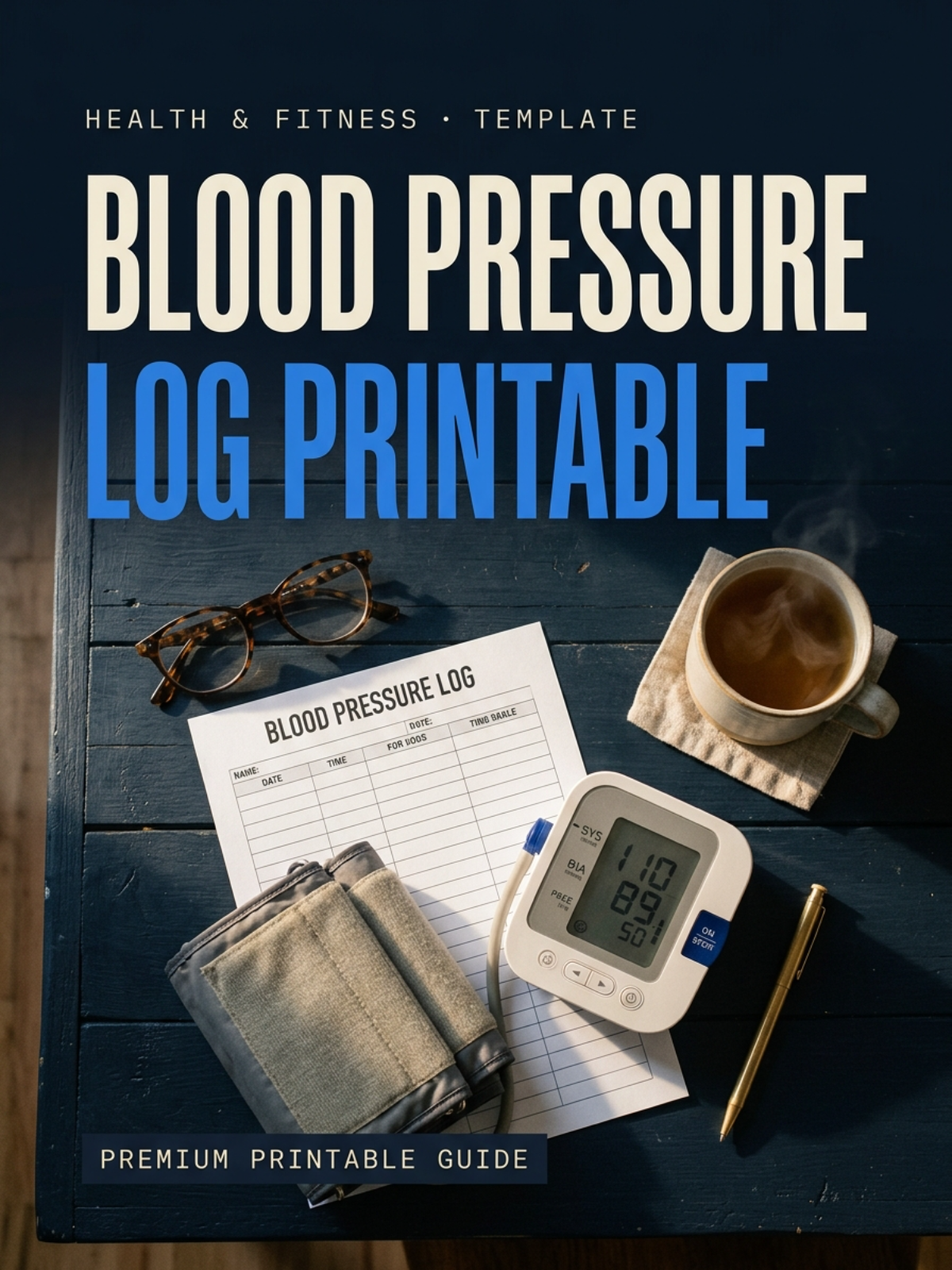
The full workbook, ready to print
- ✓3–6 months of dated daily log sheets with morning and evening rows
- ✓Weekly average calculator rows and monthly trend charts
- ✓Medication tracker and target blood pressure block
- ✓Step-by-step measurement technique card to tape near your monitor
- ✓Orthostatic (lying, 1-minute, 3-minute standing) logging grid
- ✓"Eight mistakes that make a log useless" checklist
- ✓Pre-appointment checklist plus printable questions to ask your doctor
Hosted on FileJoker. Premium members download instantly; free download has a wait.
In a hurry? Free one-page checklist30 items to tick off · print-ready PDF, no sign-upDownload freeIncluded bonuses — free with the guide
2 extra guides from the same topic Free PDF · 13 pagesSleep Log Template: Build One and Actually Read the ResultsBuild a sleep log template that shows real patterns in 14 nights. Column list, the 10-4-3-2-1 rule, and a free printable log plus daily checklist. Download it.
 Free PDF · 14 pagesWorkout Tracker Printable: Weekly, Monthly and Yearly SheetsFree workout tracker printable: weekly log, monthly grid and yearly PR ledger, plus a metric shortlist and print checklist. Download and start logging today.
A look inside the PDF
10 sections · 22 pages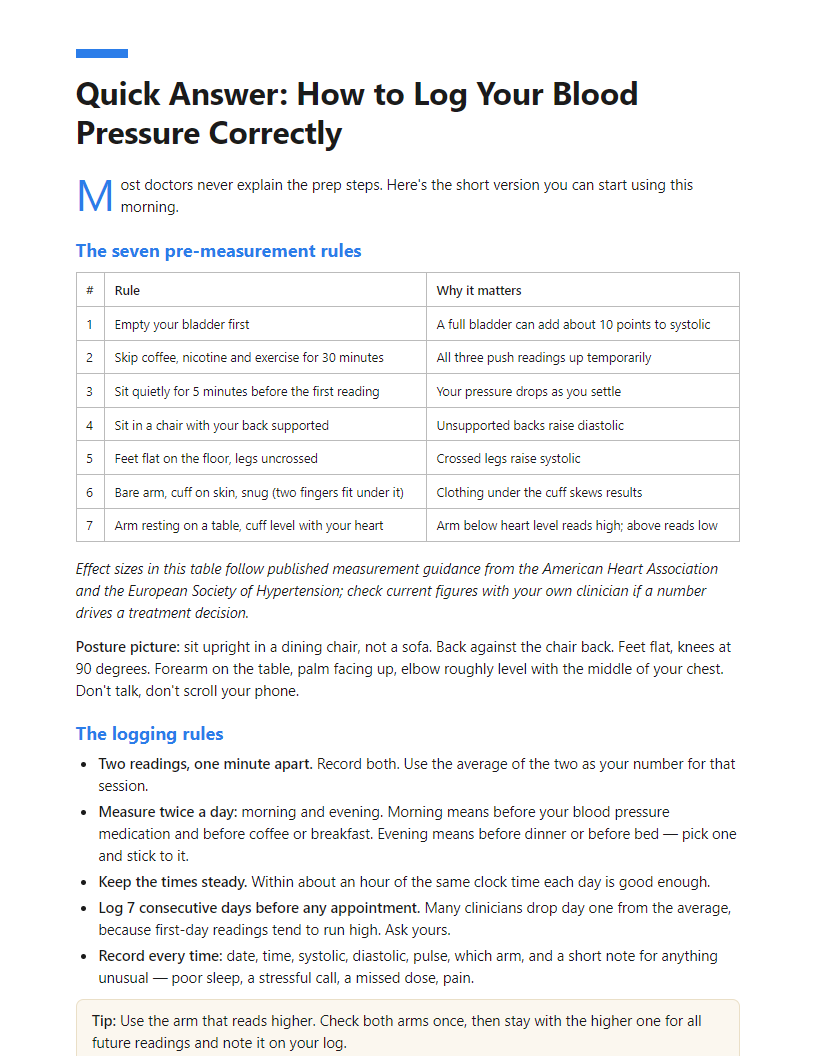
Full table of contents
- Why a Single Log Sheet Isn't Enough
- Quick Answer: How to Log Your Blood Pressure Correctly
- Measurement Technique, Step by Step
- How Often, For How Long: Building Your Logging Schedule
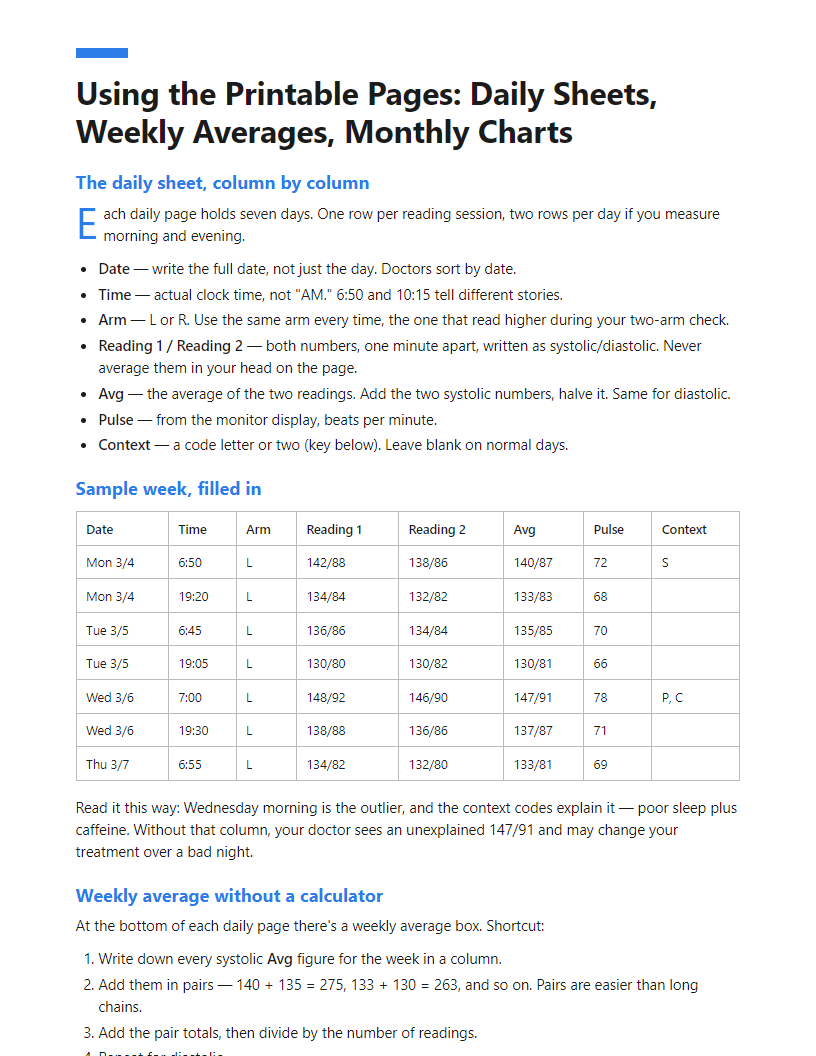
- Using the Printable Pages: Daily Sheets, Weekly Averages, Monthly Charts
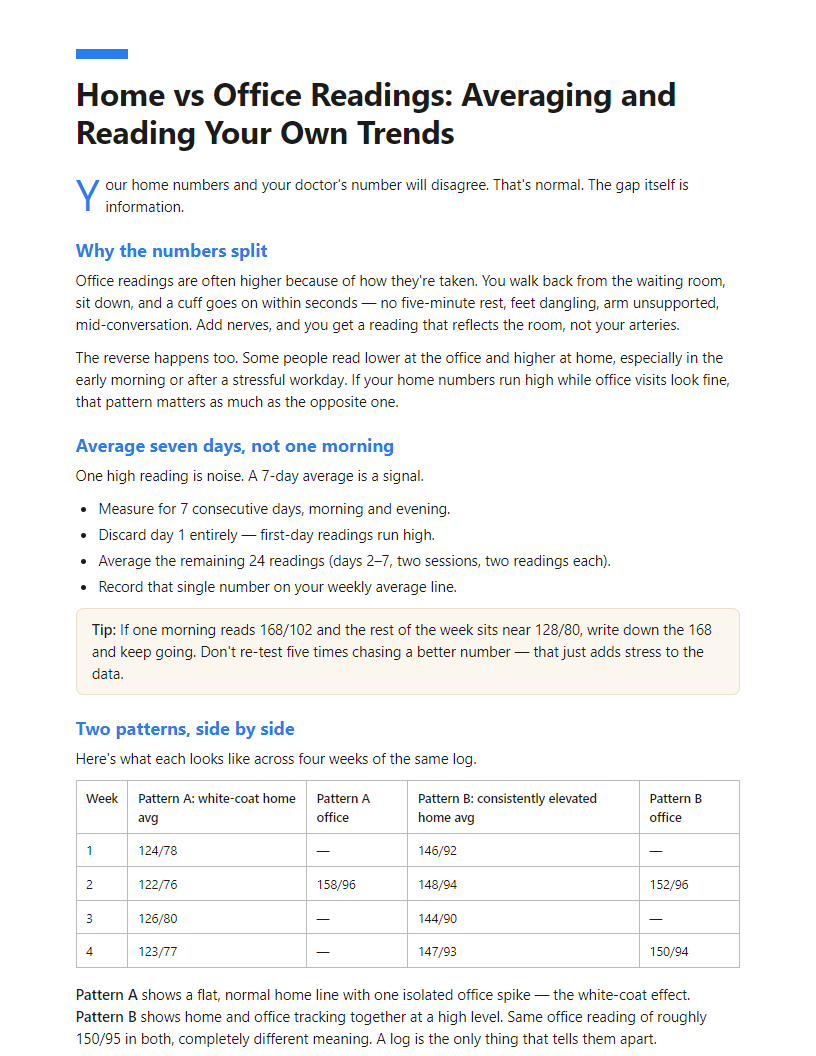
- Home vs Office Readings: Averaging and Reading Your Own Trends
- Special Situations: Appointments, Anxiety, Lying Down and Standing Up
- Eight Mistakes That Make a Blood Pressure Log Useless
- Pre-Appointment Checklist and Questions to Ask
- Printing, Storing and Going Digital
In this article
“My home numbers look nothing like the ones at the clinic — which do I report?” If you have been scribbling readings on the back of an envelope, or your nurse rushed the cuff on over a sleeve, a blood pressure log printable fixes the part you can control: consistent technique and a consistent record.
On this page you get the measurement basics, how many readings to take, and how to average home versus office numbers so a single anxious spike does not define your treatment.
The premium PDF goes further: three to six months of dated daily sheets, weekly average rows, monthly trend charts, medication and target-BP blocks, orthostatic (lying-to-standing) rows, and a pre-appointment question list you can hand straight to your doctor.
The short answer
- Prepare: empty your bladder, skip caffeine and smoking for 30 minutes, sit quietly for 5 minutes.
- Position: back supported, feet flat, legs uncrossed, arm resting at heart level on a table.
- Cuff: on bare skin, 2 cm above the elbow crease, snug enough for one finger.
- Measure: take 2–3 readings one minute apart, morning and evening.
- Log: write date, time, both numbers, pulse, arm used, and anything unusual.
- Average: after 7 days, discard day one and average the rest before your appointment.
Why a Single Log Sheet Isn’t Enough
Search “free printable blood pressure log sheet” and you’ll find hundreds of one-page grids: date, time, systolic, diastolic, pulse. They’re fine for a week. They fall apart the moment your doctor asks a real question.
A single sheet leaves out four things that matter:
- Averages. Clinicians act on averaged readings, not single numbers. A grid of raw numbers forces someone to do mental math in a 12-minute appointment.
- Medication changes. If your dose changed on March 4, your numbers before and after that date mean different things. Undated med changes make the whole log ambiguous.
- Context. A 158/96 after a stressful call is not the same as 158/96 on a calm Tuesday morning. Without a notes column, every reading looks identical.
- Trend view. Thirty numbers in a column don’t show direction. A plotted line does, in about three seconds.
Why seven days, not three readings
Home monitoring guidance generally asks for readings twice a day — morning and evening — for about seven days, with two readings each time, a minute apart. That’s roughly 28 numbers per cycle, and the first day is usually discarded. Three scattered numbers from last month tell your doctor almost nothing. A clean seven-day block with an average tells them a lot.
Who this is for
- Newly diagnosed, and asked to confirm the diagnosis at home.
- Mid-titration, where a dose just changed and both of you need to see the effect.
- Carers logging for a parent or spouse who can’t reliably record their own readings.
What this guide does not do
It won’t diagnose you, set your personal target numbers, or tell you to change a dose. Targets vary by age, kidney function, diabetes and other factors — your clinician sets yours. This guide covers technique, structure and presentation.
How the pack is organized
Daily pages for raw readings. Weekly summary sheets that calculate your average. Monthly trend charts you plot by hand in two minutes. Visit-prep sheets for appointment day. Six months of pages, so one printing covers a full treatment cycle.
Quick Answer: How to Log Your Blood Pressure Correctly
Most doctors never explain the prep steps. Here’s the short version you can start using this morning.
The seven pre-measurement rules
| # | Rule | Why it matters |
|---|---|---|
| 1 | Empty your bladder first | A full bladder can add about 10 points to systolic |
| 2 | Skip coffee, nicotine and exercise for 30 minutes | All three push readings up temporarily |
| 3 | Sit quietly for 5 minutes before the first reading | Your pressure drops as you settle |
| 4 | Sit in a chair with your back supported | Unsupported backs raise diastolic |
| 5 | Feet flat on the floor, legs uncrossed | Crossed legs raise systolic |
| 6 | Bare arm, cuff on skin, snug (two fingers fit under it) | Clothing under the cuff skews results |
| 7 | Arm resting on a table, cuff level with your heart | Arm below heart level reads high; above reads low |
Effect sizes in this table follow published measurement guidance from the American Heart Association and the European Society of Hypertension; check current figures with your own clinician if a number drives a treatment decision.
Posture picture: sit upright in a dining chair, not a sofa. Back against the chair back. Feet flat, knees at 90 degrees. Forearm on the table, palm facing up, elbow roughly level with the middle of your chest. Don’t talk, don’t scroll your phone.
The logging rules
- Two readings, one minute apart. Record both. Use the average of the two as your number for that session.
- Measure twice a day: morning and evening. Morning means before your blood pressure medication and before coffee or breakfast. Evening means before dinner or before bed — pick one and stick to it.
- Keep the times steady. Within about an hour of the same clock time each day is good enough.
- Log 7 consecutive days before any appointment. Many clinicians drop day one from the average, because first-day readings tend to run high. Ask yours.
- Record every time: date, time, systolic, diastolic, pulse, which arm, and a short note for anything unusual — poor sleep, a stressful call, a missed dose, pain.
Tip: Use the arm that reads higher. Check both arms once, then stay with the higher one for all future readings and note it on your log.
When to stop logging and call someone
A log is for trends, not emergencies. Stop measuring and get help if:
- A reading is 180/120 or higher — repeat once after 5 minutes, and if it stays there, call your doctor.
- You have chest pain, shortness of breath, weakness on one side, slurred speech, vision changes or a severe headache with a high reading. Call 911.
Home vs Office Readings: Averaging and Reading Your Own Trends
Your home numbers and your doctor’s number will disagree. That’s normal. The gap itself is information.
Why the numbers split
Office readings are often higher because of how they’re taken. You walk back from the waiting room, sit down, and a cuff goes on within seconds — no five-minute rest, feet dangling, arm unsupported, mid-conversation. Add nerves, and you get a reading that reflects the room, not your arteries.
The reverse happens too. Some people read lower at the office and higher at home, especially in the early morning or after a stressful workday. If your home numbers run high while office visits look fine, that pattern matters as much as the opposite one.
Average seven days, not one morning
One high reading is noise. A 7-day average is a signal.
- Measure for 7 consecutive days, morning and evening.
- Discard day 1 entirely — first-day readings run high.
- Average the remaining 24 readings (days 2–7, two sessions, two readings each).
- Record that single number on your weekly average line.
Tip: If one morning reads 168/102 and the rest of the week sits near 128/80, write down the 168 and keep going. Don’t re-test five times chasing a better number — that just adds stress to the data.
Two patterns, side by side
Here’s what each looks like across four weeks of the same log.
| Week | Pattern A: white-coat home avg | Pattern A office | Pattern B: consistently elevated home avg | Pattern B office |
|---|---|---|---|---|
| 1 | 124/78 | — | 146/92 | — |
| 2 | 122/76 | 158/96 | 148/94 | 152/96 |
| 3 | 126/80 | — | 144/90 | — |
| 4 | 123/77 | — | 147/93 | 150/94 |
Pattern A shows a flat, normal home line with one isolated office spike — the white-coat effect. Pattern B shows home and office tracking together at a high level. Same office reading of roughly 150/95 in both, completely different meaning. A log is the only thing that tells them apart.
The opposite of white-coat is masked hypertension: normal in the office, high at home. On your log it looks like Pattern B’s home column paired with Pattern A’s office column.
Normal daily variation
Blood pressure moves all day. Expect these swings and don’t treat them as emergencies:
- Morning surge — pressure climbs as you wake and is often highest in the first few hours.
- Post-meal dip — readings can fall after eating, sometimes noticeably in older adults.
- Evening decline — numbers typically drift down toward bedtime.
- Seasonal shift — readings commonly run a little higher in cold months than in warm ones.
This is why you log the same two times each day. Comparing a Tuesday 7 a.m. reading to a Thursday 9 p.m. reading tells you nothing.
Presenting both sets without an argument
You don’t need to decide which number is “right.” Hand over both and let the clinician do the work.
- Lead with the averages: “My 7-day home average is 124/78. Here are the daily readings behind it.”
- State your method in one sentence: cuff model, arm used, rest time, timing.
- Ask the open question: “Does the gap between my home and office numbers change your thinking?”
Warning: Your log describes patterns. It does not diagnose hypertension and it is not a reason to change, skip, or stop a medication. Only your clinician makes those calls.
Frequently Asked Questions
How many times a day should I measure, and do I log every reading?
Take two readings per session, one minute apart. Measure twice a day — morning and evening — during an active monitoring stretch. That’s four readings a day.
Log all of them. Don’t delete the high one because it “didn’t feel right.” Your doctor averages the numbers, so a discarded reading quietly skews the average. If a reading is clearly bad (you moved, the cuff slipped, you talked), note why in the comments column and take another.
My home numbers differ from the doctor’s. Which one do I report?
Report both. Bring your home average and let the office reading stand on its own.
Home averages are usually the better picture of your everyday blood pressure, because you control the prep: bathroom first, five minutes sitting, feet flat, bare arm, no talking. Office readings often skip all of that, and anxiety does the rest. If your office number jumps 20 points above your home average every single visit, that pattern is worth showing your doctor in writing.
Some people run the opposite way — higher at home than in the office. That’s worth flagging too. Either way, the fix is the same: an average from many readings, not an argument over one.
Does a full bladder really change the reading?
Yes. A full bladder can add roughly 10 to 15 points to your systolic number. Most doctors never mention it, which is why so many people only discover it after their home cuff reads lower than the office machine.
Use the bathroom, then sit quietly for five minutes, then measure. Do it the same way every time.
Can I measure lying down, or in a hospital bed?
You can, and hospitals do it constantly — it’s simply easier when someone is in bed and may be unable to sit up. But lying readings are not interchangeable with seated readings. Position changes the number, so comparing a hospital bed reading to your seated home log isn’t apples to apples.
For your log, measure seated with your back supported, feet flat on the floor, and the cuff at heart level. If your doctor specifically asks for lying and standing readings — usually to check for a drop when you stand — write the position next to each number.
Which arm should I use? Does switching matter?
It matters. Arms can differ by 10 points or more. Measure both arms once, then use the higher-reading arm from then on and stick with it for all six months.
Write the arm you chose at the top of every page. If you switch mid-log without noting it, your trend line becomes meaningless.
How long should I keep the same monitor?
Validate it once a year. Take your home cuff to your appointment, measure on your own device, then have the office measure on theirs within a minute or two on the same arm. A gap of about 5 points or less is fine.
Replace the cuff if the fabric is stretched, the Velcro no longer grips, or there are cracks in the tubing. Replace the monitor if it’s dropped, if readings swing wildly between back-to-back measurements, or if the manufacturer lists an expected service life that you’ve passed.
Is there a Spanish version or an Excel version?
The printable pack includes a Spanish-language set of the daily sheets, weekly average pages, and visit-prep sheet, with identical layout so a bilingual household can use both.
An Excel/Google Sheets version is also included. It calculates weekly averages and plots the trend chart automatically. Print those pages for your appointment — most doctors still read paper faster than a phone screen.
- ✓3–6 months of dated daily log sheets with morning and evening rows
- ✓Weekly average calculator rows and monthly trend charts
- ✓Medication tracker and target blood pressure block
- ✓Step-by-step measurement technique card to tape near your monitor
- ✓Orthostatic (lying, 1-minute, 3-minute standing) logging grid
- ✓"Eight mistakes that make a log useless" checklist
- ✓Pre-appointment checklist plus printable questions to ask your doctor
Frequently asked questions
How many blood pressure readings should I record before seeing my doctor?
Most guidelines ask for seven consecutive days of home readings: two or three measurements each morning and each evening. Discard the whole first day, which is usually artificially high, then average everything left. That gives roughly 24 readings — enough for your doctor to judge your true level rather than one office snapshot.
My home readings are lower than at the clinic. Which number counts?
Home averages are generally the better guide, because they avoid white-coat anxiety and are based on many readings rather than one. A clinic reading that is consistently 10–15 mmHg higher than your home average suggests white-coat effect. Bring your log; your doctor can compare both sets and may suggest 24-hour ambulatory monitoring to settle it.
What is the correct arm position for an accurate reading?
Rest your arm on a table so the cuff sits level with your heart. An unsupported or dangling arm can add 10 mmHg or more, and a cuff over clothing adds error too. Keep your back supported, feet flat on the floor, legs uncrossed, and stay silent during the measurement.
How do I log blood pressure lying down and standing up?
For orthostatic checks, lie flat for five minutes and measure, then stand and measure again at one minute and three minutes. Record all three with the position noted. A drop of 20 mmHg systolic or 10 mmHg diastolic on standing is worth reporting, especially if you feel dizzy or take diuretics.
Does a printable log still make sense if I use a tracking app?
Yes — many people use both. Paper captures context an app ignores: poor sleep, missed doses, pain, stressful days. Keep the printable at your monitor, then sync or photograph weekly averages into your app or patient portal. The PDF includes a short guide to transferring paper totals into digital records without double entry.
We collected 99 real questions and comments about "blood pressure log printable" (32 from YouTube comments, 67 from search suggestions), grouped them into 12 recurring problems, and built this guide to resolve the 6 that block people most. The top-ranking pages were reviewed for gaps; 7 of those gaps became dedicated sections.
Edited by Alex Horn · Last updated November 19, 2026 · How we make our guides
More in Health & Fitness
 premium+2 bonuses
 premium+2 bonusesfreefree