Template · 25-page PDF · Premium
Running Training Plan for Half Marathon: Choose Your Weeks and Days
Pick a running training plan for half marathon in 12, 16 or 18 weeks on 2–5 days. Pace tables, injury rules and a weekly progress checklist inside. Download it.

The full workbook, ready to print
- ✓One-session pace test with a half marathon pace conversion table
- ✓Full week-by-week templates for beginner, intermediate and advanced on 12, 16 and 18 weeks
- ✓2-day, 3-day, 4-day and 5-day weekly planning grids
- ✓Missed-week recovery rules and a shin splint / IT band / knee triage chart
- ✓Long-run fuelling and race-morning timing table
- ✓Taper schedule, race-day pacing splits and bathroom-stop timing plan
- ✓Printable weekly progress tracker and pre-start readiness checklist
- ✓Block-linking guide for repeat halves and marathon build-ups
Hosted on FileJoker. Premium members download instantly; free download has a wait.
In a hurry? Free one-page checklist22 items to tick off · print-ready PDF, no sign-upDownload freeIncluded bonuses — free with the guide
2 extra guides from the same topic Free PDF · 13 pagesSleep Log Template: Build One and Actually Read the ResultsBuild a sleep log template that shows real patterns in 14 nights. Column list, the 10-4-3-2-1 rule, and a free printable log plus daily checklist. Download it.
 Free PDF · 14 pagesWorkout Tracker Printable: Weekly, Monthly and Yearly SheetsFree workout tracker printable: weekly log, monthly grid and yearly PR ledger, plus a metric shortlist and print checklist. Download and start logging today.
A look inside the PDF
10 sections · 25 pages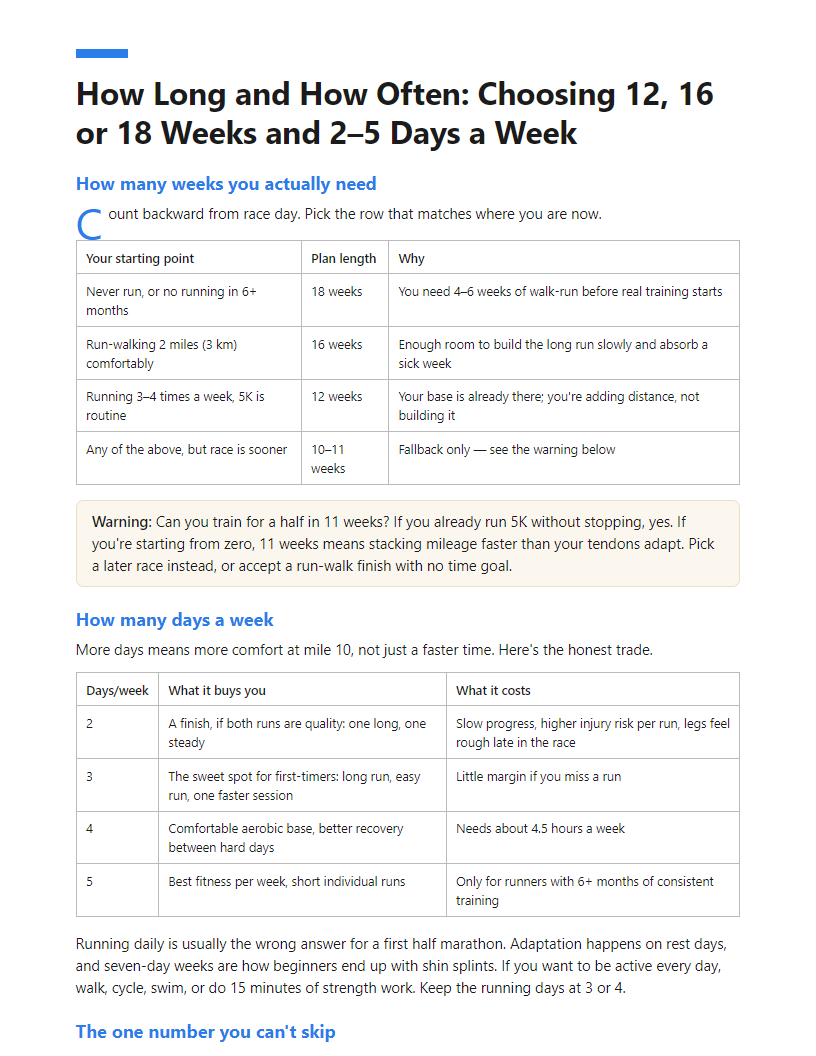
Full table of contents
- Who This Plan Set Is For (and the Honest Prerequisites)
- How Long and How Often: Choosing 12, 16 or 18 Weeks and 2–5 Days a Week
- Find Your Real Half Marathon Pace in One Test Session
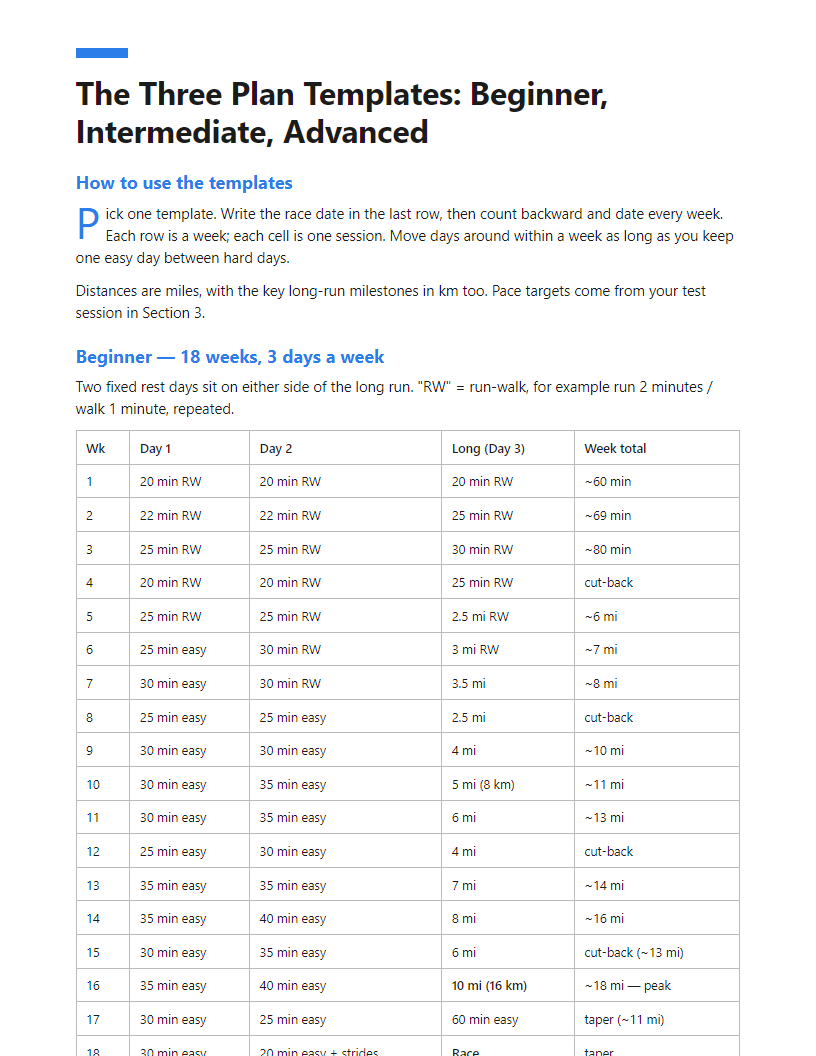
- The Three Plan Templates: Beginner, Intermediate, Advanced
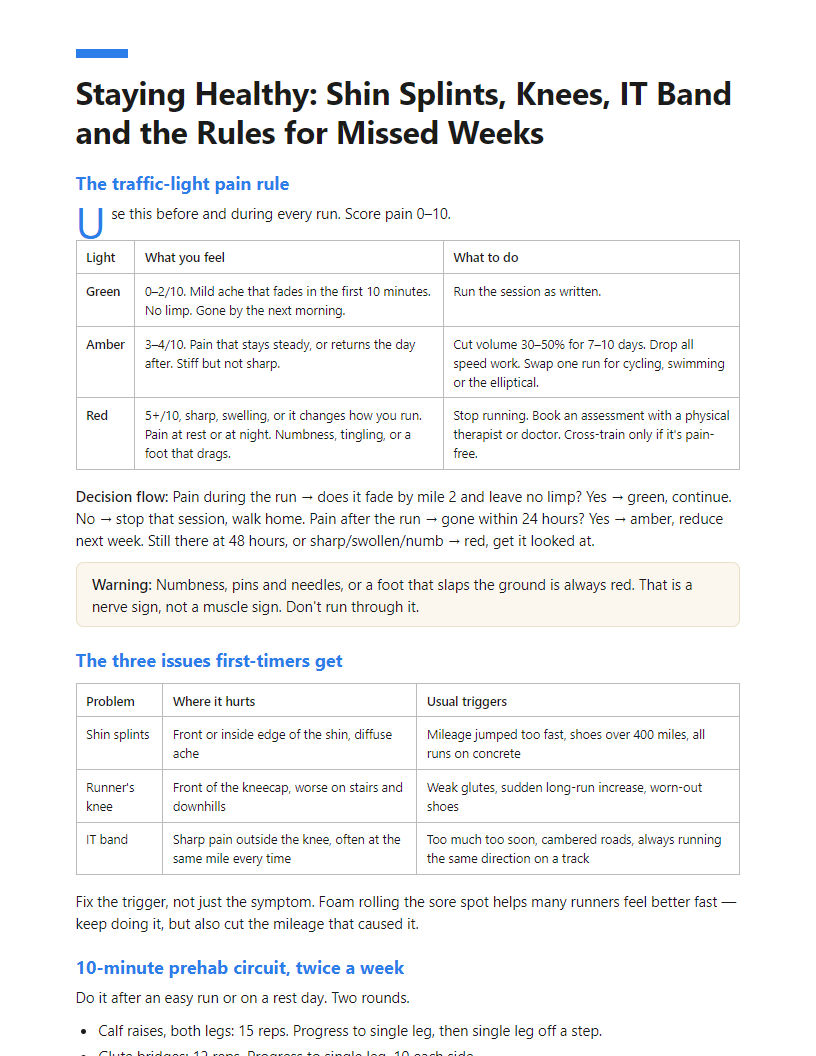
- Staying Healthy: Shin Splints, Knees, IT Band and the Rules for Missed Weeks
- Fuelling the Long Runs and Race Morning
- Taper, Race-Day Pacing and Bathroom Logistics
- Seven Mistakes That Derail Half Marathon Training
- Linking Training Blocks: Repeat Halves and Marathon Build-Ups
- Pre-Start and Weekly Progress Checklist
In this article
“I’ve never run 13.1 miles — can my body even do this, and how many weeks do I actually need?” If that’s your question, you’re in the right place. This running training plan for half marathon guide shows you how to choose between 12, 16 and 18 weeks, how to run 2, 3, 4 or 5 days a week without breaking down, and the honest prerequisites before week one. You’ll see the seven mistakes that wreck most first attempts and clear answers on frequency and realistic timelines.
The premium PDF adds the full package: beginner, intermediate and advanced templates week by week, a one-session pace test, fuelling and taper tables, injury rules for missed weeks, and a printable progress tracker.
The short answer
A realistic running training plan for half marathon follows five steps:
- Check your base — run 30 minutes continuously, or spend 4–6 weeks building to it first.
- Choose your length — 12 weeks if you already run 15–20 km a week, 16–18 weeks as a first-timer or returner.
- Set frequency — 3 days a week is the sweet spot; 2 days works with cross-training, 4–5 for advanced runners.
- Structure each week — one long run, one easy run, one quality session, rest or cross-training between.
- Build and taper — add roughly 10% weekly, deload every fourth week, taper the final 10–14 days.
Who This Plan Set Is For (and the Honest Prerequisites)
Three places people start
Find yourself in one of these rows. It decides which plan you open first.
| Starting point | What it looks like now | Where to go |
|---|---|---|
| Never run | No regular running. Walking is fine. | 4-week base-building phase, then the Beginner plan (18 weeks) |
| Run-walk 20 minutes comfortably | 2–3 sessions a week, mixing jogging and walking | Beginner plan, 16 or 18 weeks |
| Already running 10–15 miles (15–25 km) a week | Longest run 4–6 miles, consistent for a month | Intermediate plan, 12 or 16 weeks |
The 3-minute readiness self-check
Answer honestly. No one else sees this.
- Longest run or run-walk in the last 14 days? Under 1 mile means start with base-building.
- How many weeks in a row have you trained at least twice? Fewer than three weeks of consistency means add the base phase.
- Any pain that is still there 48 hours after a run? That includes shin pain, knee pain that sharpens on stairs, or numbness and foot drop. Get it assessed before you add mileage.
- Can you walk briskly for 45 minutes? If not, build that first. It is the floor the whole plan stands on.
“Too slow, too heavy, too old”
None of those are verdicts. They change the design of the plan, not whether you can finish 13.1 miles. Slower runners spend longer on their feet, so these plans cap the long run by time as well as distance. Heavier or older runners get more recovery days and a run-walk structure that keeps impact lower. Plenty of people run a first half in their fifties, and a 2:30 finish counts exactly as much as a 1:30.
What this guide is not
This is educational, not medical advice. Stop and see a clinician for pain that worsens during a run, swelling, numbness or tingling, chest symptoms, or any injury you already have on file — meniscus tears and nerve damage need a professional plan, not a template.
How the files fit together
Plan selector (Section 2) → your weekly template (Section 4) → pace table (Section 3) → progress tracker (Section 10) → race-day script (Section 7). Work through them in that order.
How Long and How Often: Choosing 12, 16 or 18 Weeks and 2–5 Days a Week
How many weeks you actually need
Count backward from race day. Pick the row that matches where you are now.
| Your starting point | Plan length | Why |
|---|---|---|
| Never run, or no running in 6+ months | 18 weeks | You need 4–6 weeks of walk-run before real training starts |
| Run-walking 2 miles (3 km) comfortably | 16 weeks | Enough room to build the long run slowly and absorb a sick week |
| Running 3–4 times a week, 5K is routine | 12 weeks | Your base is already there; you’re adding distance, not building it |
| Any of the above, but race is sooner | 10–11 weeks | Fallback only — see the warning below |
Warning: Can you train for a half in 11 weeks? If you already run 5K without stopping, yes. If you’re starting from zero, 11 weeks means stacking mileage faster than your tendons adapt. Pick a later race instead, or accept a run-walk finish with no time goal.
How many days a week
More days means more comfort at mile 10, not just a faster time. Here’s the honest trade.
| Days/week | What it buys you | What it costs |
|---|---|---|
| 2 | A finish, if both runs are quality: one long, one steady | Slow progress, higher injury risk per run, legs feel rough late in the race |
| 3 | The sweet spot for first-timers: long run, easy run, one faster session | Little margin if you miss a run |
| 4 | Comfortable aerobic base, better recovery between hard days | Needs about 4.5 hours a week |
| 5 | Best fitness per week, short individual runs | Only for runners with 6+ months of consistent training |
Running daily is usually the wrong answer for a first half marathon. Adaptation happens on rest days, and seven-day weeks are how beginners end up with shin splints. If you want to be active every day, walk, cycle, swim, or do 15 minutes of strength work. Keep the running days at 3 or 4.
The one number you can’t skip
Before the taper, you need a longest run of 10–12 miles (16–19 km). Not the full 13.1. That final 1–3 miles comes from race-day adrenaline and the taper.
Build toward it by adding roughly 10% to your weekly total each week, then cutting back every fourth week. Every plan here already does this math for you.
Miles or kilometers
Both. Every workout in every plan is printed in miles with the kilometer figure next to it, so no one has to convert mid-week.
| Miles | 1 | 3 | 5 | 6.2 | 8 | 10 | 12 | 13.1 |
|---|---|---|---|---|---|---|---|---|
| Kilometers | 1.6 | 4.8 | 8 | 10 | 12.9 | 16.1 | 19.3 | 21.1 |
Seven Mistakes That Derail Half Marathon Training
1. Running every easy run too fast
Easy means conversational. If you can’t speak a full sentence, you’re not running easy. Too-fast easy runs are the top cause of stalled progress, flat legs and shin pain — your calves and shins absorb the extra load long before your lungs complain. Fix: run easy days 1:30–2:30 per mile slower than your goal half pace, and let the pace be ugly.
2. Jumping plan levels mid-cycle
Week 5 feels good, so you switch from beginner to intermediate. Now you’ve added days, distance and intensity at once. Fix: stay on your plan and adjust inside it — add 5–10 minutes to one easy run, or bump the long run by 1 mile. If you still feel underworked after three more weeks, add one day, not a whole level.
3. Adding distance and speed in the same week
Pick one stressor per week. A longer long run or a harder interval session, never both. This matters most if you run 2–3 days a week, because each run carries more load than it would in a 5-day plan.
4. Skipping the long run but keeping midweek volume
The long run is the session that makes 13.1 possible. If the week gets tight, cut a midweek easy run, shorten the workout, and protect the long run. If you must move it, move it — Monday long runs are fine.
5. Treating rest days as optional
Rest is when the adaptation happens. On a 2- or 3-day plan, the rest days are the reason the plan works. Cross-training isn’t wasted time either: cycling, swimming, elliptical and 10–15 minutes of mobility and core keep your aerobic fitness while your joints recover.
Tip: If you’re coming back from a meniscus tear, nerve issue or any surgery, short daily mobility and core work is usually what lets you run again without resetting every two weeks. Get your specific clearance from your doctor or physical therapist first.
6. Borrowing a goal pace from a friend
Your friend ran 1:55, so you plan for 1:55. That’s a guess, not a target. Use your own test result from Section 3 — a 1-mile time trial, a 5K, or a 30-minute steady effort — and recheck it around week 6. A goal pace built on your own data is why people hit 1:58 instead of fading to 2:11.
7. New anything on race day
No new shoes, gels, socks, shorts, sports bra or breakfast. Race in shoes with 30–100 miles on them. Everything you wear and eat on race morning should have been tested on at least two long runs.
Frequently Asked Questions
How long does it realistically take to train for a half marathon?
Between 10 and 18 weeks, depending on your starting point. Section 2 has the table that matches your current running to a plan length — use that rather than guessing.
Can I do it in 11 weeks from scratch?
You can usually reach the finish line, but you raise your injury risk and you will likely walk sections. If the date is fixed, use the beginner plan, drop the first weeks rather than the last, and accept a run-walk finish with no time goal.
What does a realistic plan look like?
Three to four runs a week, one of them longer than the others. Most of your running is easy and conversational — slow enough to speak in full sentences.
The long run grows by roughly 10 minutes or 1 mile per week, with a cutback week every third or fourth week. Longest run of 10–12 miles. Two weeks of taper. That’s it — no magic workouts required. If a plan you find online has three hard sessions a week and no cutbacks, it isn’t written for a first-timer.
What is the 5-4-3-2-1 running method?
It’s a weekly structure of five sessions with descending effort or time: a long run, a tempo run, an interval session, a shorter easy run and a short recovery run or cross-training day. Some versions use descending mileage (5 miles, 4, 3, 2, 1).
It can work for a half, but only if you already run five days a week comfortably. For a first-timer it packs too much quality into too few weeks, and the recovery day rarely stays easy. Stick to one long run, one faster session and one or two easy runs. You can move to a five-day structure in your second or third training block.
How often should I run to train for a half marathon?
Three days a week suits most first-timers; four suits runners with a base and a time goal. Section 2 lays out what each frequency buys you and what it costs, including the two-day option and why daily running is the wrong call for a first build.
Can I walk part of a half marathon?
Yes. Walk breaks are a strategy, not a failure. Planned run-walk — for example 9 minutes running, 1 minute walking from mile 1 — often produces a faster finish than running until you fall apart at mile 9.
Pick your ratio early and practice the exact numbers on every long run, so race day feels familiar. Walk through aid stations rather than running while you drink. Start the walk breaks from the first mile, not from the mile where you start to struggle.
Do I need to run the full 13.1 miles in training?
No. Build to 10–12 miles — Sections 2 and 4 explain why that’s enough and what covers the last few miles on race day.
- ✓One-session pace test with a half marathon pace conversion table
- ✓Full week-by-week templates for beginner, intermediate and advanced on 12, 16 and 18 weeks
- ✓2-day, 3-day, 4-day and 5-day weekly planning grids
- ✓Missed-week recovery rules and a shin splint / IT band / knee triage chart
- ✓Long-run fuelling and race-morning timing table
- ✓Taper schedule, race-day pacing splits and bathroom-stop timing plan
- ✓Printable weekly progress tracker and pre-start readiness checklist
- ✓Block-linking guide for repeat halves and marathon build-ups
Frequently asked questions
How long does it realistically take to train for a half marathon?
If you can already run 30 minutes without stopping, 12 weeks is realistic. If you're starting from little or no running, allow 16–20 weeks: 4–6 weeks of walk-run base building, then a 12–16 week plan. Returning after injury or a long break? Add four extra weeks. Rushing the base phase is the single most common cause of shin splints and pulled-out entries.
What does a realistic half marathon training plan look like?
Three to four runs a week: one long run that grows from 5 km to 16–18 km, one easy recovery run, one quality session (intervals or tempo), plus optional cross-training. Weekly volume rises about 10% with a lighter week every fourth. The last 10–14 days taper by 40–60% so you arrive fresh rather than fatigued.
What is the 5 4 3 2 1 running method?
It's a weekly template of five sessions: a 5-mile steady run, a 4-mile tempo, a 3-mile interval session, a 2-mile recovery jog and a 1-mile fast effort or strides. It gives variety without planning each week from scratch. For half marathon training the distances scale up, with the long run replacing the 5-mile steady as the anchor session.
How often should I run to train for a half marathon?
Three days a week is enough to finish a half marathon comfortably, and it's the lowest-injury option for most people. Two days works if you add two cross-training sessions (bike, swim, rowing) and protect the long run. Four to five days suits experienced runners chasing a time goal. Consistency over months beats high frequency for a few weeks.
How do I work out my target half marathon race pace?
Run a recent all-out 5K, then add roughly 30–40 seconds per kilometre (50–65 seconds per mile) for your half pace. No recent race? Run 20 minutes at the hardest pace you can hold evenly and use that as a reference. Test again around week 8 and adjust. The PDF includes a single-session pace test and a full conversion table.
What should I do if shin splints or knee pain start mid-plan?
Cut volume by half for a week, drop intensity, and swap runs for cycling or pool running — pain that eases within a week rarely costs you the race. Check shoe mileage (replace above 600–800 km), slow your easy runs, and add calf and glute strength twice weekly. Pain that worsens, localises to a point, or persists at rest needs a physio, not another week of guessing.
We collected 132 real questions and comments about "running training plan for half marathon" (73 from YouTube comments, 4 from People Also Ask, 55 from search suggestions), grouped them into 12 recurring problems, and built this guide to resolve the 6 that block people most. The top-ranking pages were reviewed for gaps; 7 of those gaps became dedicated sections.
Edited by Alex Horn · Last updated November 23, 2026 · How we make our guides
More in Health & Fitness
 premium+2 bonuses
 premium+2 bonusesfreefree